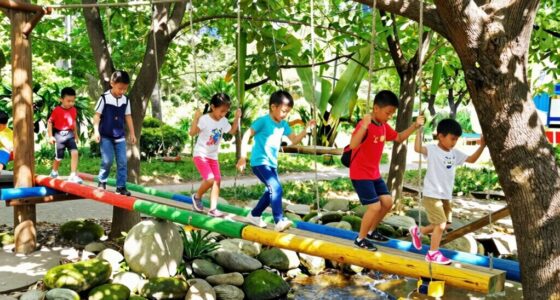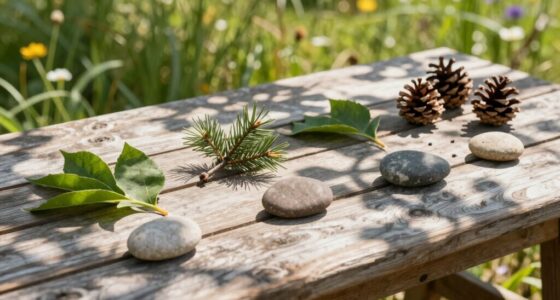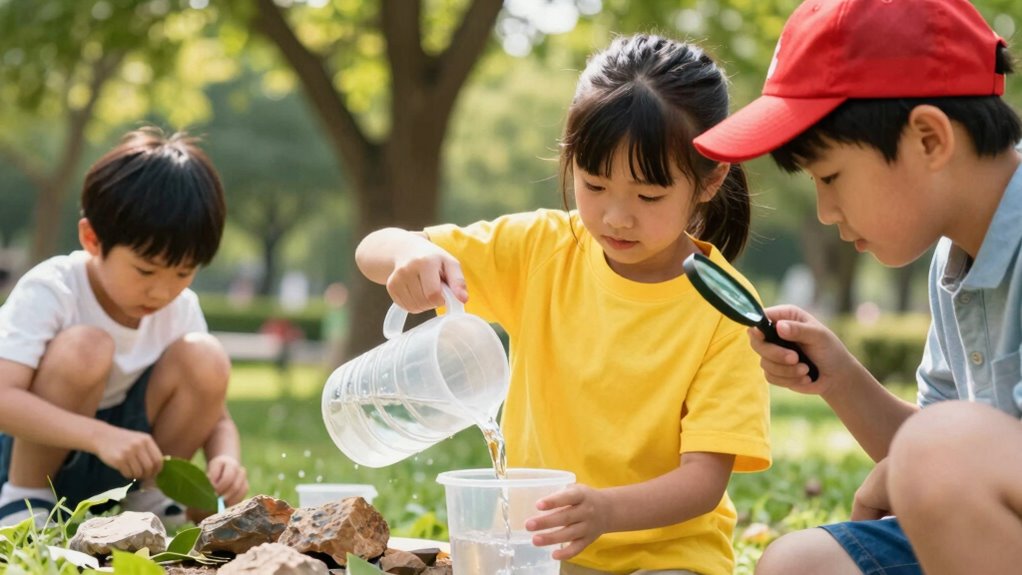

You can support early science skills by encouraging outdoor play activities like collecting leaves, rocks, and flowers, which helps children classify and compare natural objects. Activities like water absorption experiments or observing plant growth foster hands-on learning and scientific thinking. Group games like scavenger hunts promote teamwork and problem-solving. To learn more about how these activities boost curiosity and understanding of ecosystems, keep exploring the tips below.
Listen free for 30 days with Audible
Thousands of audiobooks and originals — cancel anytime.
As an affiliate, we earn on qualifying purchases.
Key Takeaways
- Conduct simple experiments like water absorption and plant growth to promote observation and hypothesis testing.
- Collect natural objects such as leaves and rocks to enhance classification and data recording skills.
- Organize scavenger hunts and group activities to develop teamwork, communication, and scientific thinking.
- Explore ecosystems and practice eco-friendly behaviors to increase environmental awareness and sustainability understanding.
- Encourage curiosity and inquiry through outdoor exploration, fostering early scientific skills and lifelong interest in science.
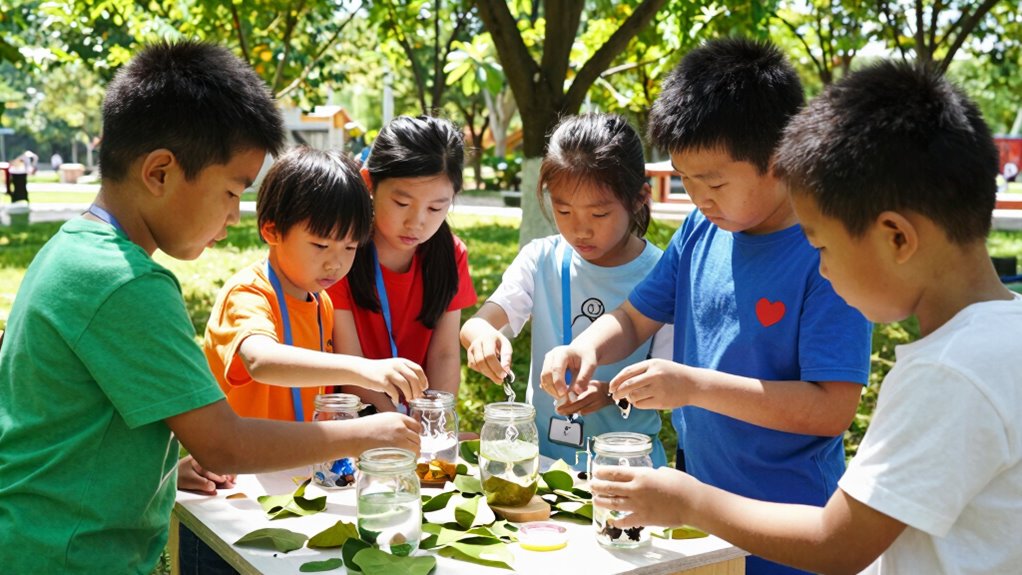
Scientific experiments become even more exciting when done outdoors because the natural setting provides an ideal laboratory for hands-on learning. You can facilitate simple experiments like testing which materials absorb water the fastest or observing how plants grow under different conditions. These activities allow children to hypothesize, test, and draw conclusions, mirroring real scientific processes. As they experiment, they learn to think critically and problem-solve, skills essential for early science literacy.
Encouraging children to collect natural objects like leaves, rocks, or flowers fosters an understanding of classification and data collection. You might set up a mini field station where they record findings or compare specimens, helping them grasp basic scientific methods. When kids see the immediate results of their experiments, their confidence in exploring scientific ideas increases. Plus, outdoor activities make science feel less like a chore and more like an adventure. Understanding the scientific method helps children approach experiments systematically and with curiosity.
In addition to individual exploration, group activities like scavenger hunts or collaborative experiments promote social skills alongside scientific thinking. Kids learn to share observations, discuss hypotheses, and work together to solve problems. These interactions build communication skills and teach them the value of teamwork in scientific discovery. Exploring natural environments enhances their understanding of ecosystems and sustainability, reinforcing the importance of eco-friendly practices in backyard design. Incorporating outdoor safety precautions ensures that children can explore freely while staying protected during their scientific adventures. Recognizing the significance of early science skills in childhood development encourages nurturing curiosity and inquiry from a young age. Developing a sense of scientific curiosity during outdoor activities can foster a lifelong love for learning and discovery.
outdoor science experiment kits for kids
As an affiliate, we earn on qualifying purchases.
As an affiliate, we earn on qualifying purchases.
Frequently Asked Questions
How Can Outdoor Play Boost Early Science Interest?
Outdoor play boosts early science interest by engaging you in nature exploration and weather observation. When you explore the outdoors, you discover plants, insects, and animals, sparking curiosity about how things work. Observing weather changes helps you understand natural patterns. These activities make science fun and real, encouraging your natural curiosity. As you interact with nature, you develop a love for learning and a foundation for future scientific thinking.
What Safety Precautions Are Essential During Outdoor Science Activities?
You should always guarantee safety gear like goggles, gloves, and hats are used during outdoor science activities. Supervision techniques are vital—keep a close watch, stay within arm’s reach, and set clear rules. Check the environment first for hazards like sharp objects or unstable surfaces. By prioritizing safety gear and supervision, you create a secure space where children can explore and learn confidently without unnecessary risks.
How Do Outdoor Activities Support Sensory Development in Children?
Imagine a child exploring a forest, touching leaves, listening to birds, and smelling flowers — this is sensory exploration that boosts their development. Outdoor activities foster sensory development through nature immersion, engaging multiple senses simultaneously. These experiences enhance their ability to distinguish textures, sounds, and smells, which are essential for cognitive growth. By actively exploring the environment, children strengthen their sensory pathways and develop a deeper understanding of the world around them.
What Age Is Appropriate for Different Outdoor Science Experiments?
You can introduce outdoor science experiments to children as young as three, focusing on simple, age-appropriate experiment types like observing bugs or exploring water. For five- to seven-year-olds, you can try basic plant growth or weather observations, which develop critical thinking. As children grow older, around eight and up, you can explore more complex experiments like soil testing or solar energy projects, always matching experiment types to their age and developmental level.
How Can Parents Incorporate STEM Concepts Into Outdoor Play?
You can incorporate STEM concepts into outdoor play by encouraging nature exploration and experimental gardening. Take your child on nature walks to observe plants, insects, and rocks, asking questions that spark curiosity. Try simple gardening projects where they can plant seeds, water, and observe growth. This hands-on approach helps them understand scientific ideas like ecosystems, plant life cycles, and cause-and-effect through engaging, real-world experiences outdoors.
nature collection and classification set
As an affiliate, we earn on qualifying purchases.
As an affiliate, we earn on qualifying purchases.
Conclusion
By engaging in outdoor play activities, you nurture curiosity, spark creativity, and build confidence in early science skills. You encourage exploration, foster discovery, and inspire wonder in the natural world. You promote hands-on learning, develop critical thinking, and ignite a lifelong love of science. With each outdoor adventure, you help children connect, learn, and grow, laying a strong foundation for future scientific exploration. Through play, you turn everyday moments into opportunities for endless discovery.
kids water absorption experiment kit
As an affiliate, we earn on qualifying purchases.
As an affiliate, we earn on qualifying purchases.
children's outdoor scavenger hunt game
As an affiliate, we earn on qualifying purchases.
As an affiliate, we earn on qualifying purchases.
Flea & tick season Picks
flea and tick prevention
As an affiliate, we earn on qualifying purchases.