
TL;DR

Get health and wellness essentials delivered free with Prime
- Fast, free delivery on millions of items
- Prime Video, Amazon Music and more included
- Member-only deals all year
Fit&Well published a senior personal trainer’s 10-minute, no-equipment circuit for adults over 60, with chair squats, wall push-ups and standing knee-to-elbow movements. The trainer recommends three circuits of 10 repetitions per exercise, three to four times a week, while noting that form, support and individual ability matter.
Fit&Well has published a 10-minute, equipment-free strength circuit that a personal trainer says they give clients over 60 to do at home between training sessions. The routine combines chair squats, wall push-ups and standing knee-to-elbow movements, with three rounds of 10 repetitions per exercise; the trainer says beginners can take longer than 10 minutes while building up.
The trainer describes the routine as a circuit: complete 10 repetitions of each movement, then start again from the beginning after finishing all three. The suggested total is three circuits, with brief rests between exercises. The 10-minute estimate is approximate, and the source says it is acceptable if the session takes longer at first.
For chair squats, stand with a chair behind you, reach your arms forward and bend at the hips and knees to tap the seat before standing. If that is difficult, the trainer says to sit fully before rising or hold a wall or another stable structure for support. Wall push-ups are performed facing a wall, lowering the chest toward it with bent elbows, then pushing back to standing. Moving closer to the wall makes the exercise easier; stepping farther away makes it harder.
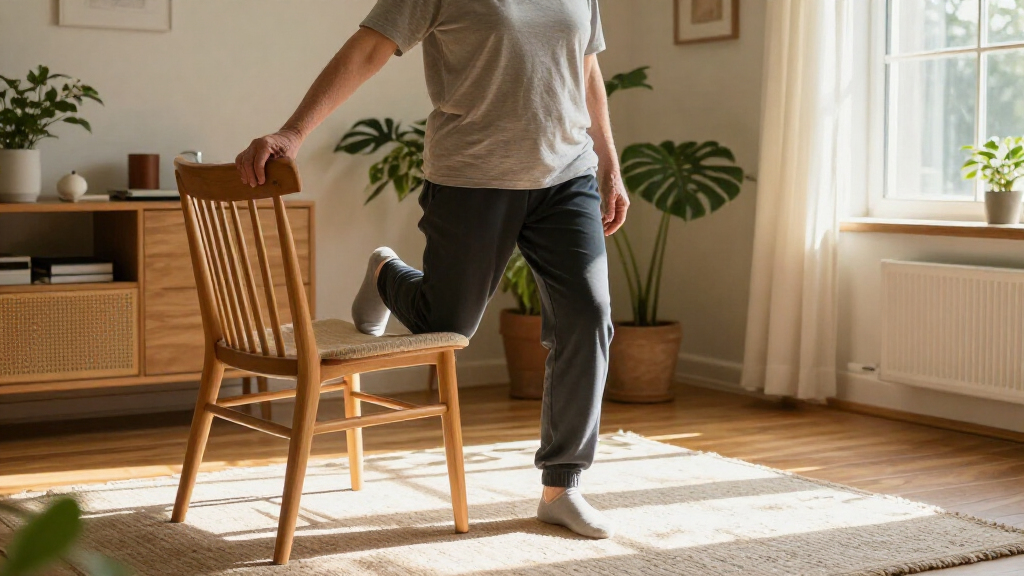
For the final movement, lift one knee while bringing the opposite elbow toward it, then alternate sides. The prescribed amount is 10 repetitions per side. The trainer advises people with balance concerns to work one side at a time while holding a wall or chair, and says touching elbow to knee is not required. The article suggests doing the routine three to four times a week, but does not present that schedule as individualized medical guidance.
A Short Routine for Home Strength
The routine offers a structured option between supervised workouts using familiar movements and no exercise equipment. Its chair and wall variations may let people adjust how challenging the exercises feel, while a stable surface can provide support during the standing movement.
The practical value is its simplicity, not a demonstrated health outcome: the supplied report does not include research testing this specific circuit or evidence that it improves strength, balance or other measures. The trainer’s recommendation is intended for their clients, and readers’ abilities and health needs can differ. Anyone unsure whether the movements are appropriate, or experiencing pain, should seek guidance from a qualified professional before continuing.
Products Worth Considering

Bowflex PR1000 Home Gym

BowFlex Results Series SelectTech 552 Adjustable Dumbbell

Withings Body Scan Smart Scale with Segmental Body Composition and ECG, Black
As an affiliate, we earn on qualifying purchases.
How the Trainer Structures the Circuit
The source frames the workout as something the trainer’s senior clients can do at home between sessions. It combines lower-body work, an upper-body push and a standing core-focused movement, with no equipment required beyond a chair and wall or other stable support if needed.
Although the report calls the movements beginner-appropriate, it also warns that incorrect technique could cause pain or injury. The trainer says a personal trainer can teach proper form and help determine when someone is ready to progress. The article does not provide a named trainer, clinical review or specific assessment of who should avoid the routine.
Limits of the Workout Guidance
The supplied report does not identify the trainer by name, give the article’s publication date, or cite studies evaluating this exact workout. It also does not specify how the routine should be modified for particular health conditions, mobility limitations or recovery needs. The 10-minute duration is an estimate, dependent on pace and rest, rather than a guaranteed session length.
The article’s general safety notes are not a substitute for individualized advice. It says the exercises can cause pain or injury if performed incorrectly and recommends learning proper form. It does not establish that every adult over 60 can safely perform all three movements, or that the suggested frequency is suitable for every reader.
Adjusting Pace and Support
The trainer’s guidance is to begin at a manageable pace, rest briefly as needed and continue practicing until less rest is needed between movements. People who need support can use a chair or wall for balance, while chair squats can be scaled by sitting fully before standing. The report does not give a fixed progression timetable or say how quickly participants should increase repetitions.
Readers considering the routine should pay attention to how the movements feel and seek advice from a qualified fitness or health professional if they are unsure about form, suitability or pain. The source provides no follow-up results or further planned update, so whether the routine produces measurable benefits for participants is not reported.
Key Questions
What exercises are in the routine?
The circuit includes chair squats, wall push-ups and standing knee-to-elbow movements. No exercise equipment is specified, though a chair and wall can be used for the movements and support.
How many repetitions should I do?
The trainer prescribes 10 repetitions of each exercise per circuit, with 10 knee-to-elbow repetitions on each side. The suggested session is three circuits, with brief rests between exercises.
How often does the trainer recommend doing it?
The report says the trainer recommends three to four times per week. It does not establish that this frequency is right for every person, so individual needs may call for professional guidance.
Does the workout have to take exactly 10 minutes?
No. Ten minutes is an estimate for three circuits with short rests. The trainer says it is fine if the workout takes longer at first.
What if I have balance concerns or the movements hurt?
The trainer suggests holding a wall or chair for support during the standing movement and using a comfortable range of motion. The report warns that poor technique can cause pain or injury; if you are unsure whether an exercise is suitable or experience pain, consult a qualified professional.
Source: fitandwell.com