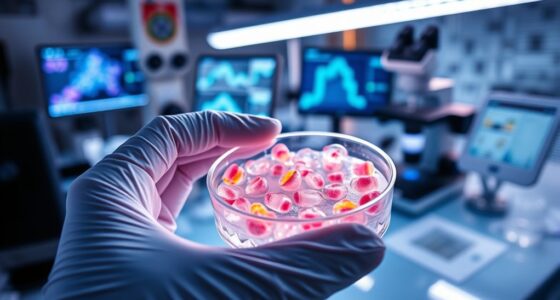
Nanomedicine uses nanotechnology to improve drug delivery by targeting specific cells and tissues, reducing side effects and increasing treatment effectiveness. You can design nanocarriers from materials like lipids or polymers that can navigate biological barriers and release drugs in response to environmental triggers like pH changes or enzymes. Surface modifications such as ligands or antibodies help these carriers find their targets more precisely. Keep exploring to discover how these innovations are shaping personalized and efficient healthcare solutions.
Key Takeaways
- Nanomedicine employs nanocarriers to deliver drugs precisely to target cells, enhancing treatment efficacy.
- Surface functionalization with ligands or antibodies enables specific recognition of diseased tissues.
- Nanocarriers can be engineered to respond to environmental stimuli, releasing drugs at the desired site.
- Using materials like lipids or polymers, nanocarriers improve drug stability and circulation time.
- Challenges include ensuring biocompatibility, scalability, and safe transition from research to clinical application.

Nanomedicine has revolutionized drug delivery by enabling targeted and efficient treatment at the cellular level. With advancements in nanotechnology, you now have the ability to direct therapeutic agents precisely where they’re needed, minimizing side effects and maximizing effectiveness. Central to this progress is the concept of targeted therapy, which focuses on delivering drugs directly to diseased cells, sparing healthy tissue. This approach relies heavily on the design of nanocarriers, tiny particles engineered to carry drugs and navigate the complex biological environment.
Nanomedicine enables precise, targeted drug delivery, minimizing side effects and enhancing treatment efficiency.
When it comes to nanocarrier design, you’re working with materials that are small enough to pass through biological barriers and reach specific cells or tissues. These nanocarriers can be made from lipids, polymers, or inorganic substances, each chosen based on the drug’s characteristics and the target tissue. The goal is to create a carrier that’s stable in circulation, can evade the immune system, and releases its payload precisely when it reaches its destination. By manipulating size, shape, surface properties, and functionalization, you can optimize nanocarriers for targeted therapy.
Effective nanocarrier design involves coating their surface with ligands, antibodies, or peptides that recognize and bind to specific markers on target cells. This functionalization ensures that the nanocarriers preferentially accumulate in the diseased tissue, such as tumors, reducing off-target effects. You can also engineer the nanocarriers to respond to specific stimuli in the environment, like pH changes or enzymes, triggering drug release only at the site of interest. This level of control enhances the therapeutic index and reduces toxicity.
In addition, you need to factor in circulation time and biodistribution. Surface modifications, such as PEGylation, help nanocarriers evade immune detection, prolonging their presence in the bloodstream. This increases the chances of reaching the target site. As you refine nanocarrier design, you’re also addressing challenges like stability, scalability, and biocompatibility, ensuring these systems can transition from laboratory research to real-world applications. Understanding biodistribution and circulation is crucial for optimizing nanomedicine efficacy and safety.

Nanomedicine Based Drug Delivery Systems: Recent Developments and Future Prospects
As an affiliate, we earn on qualifying purchases.
As an affiliate, we earn on qualifying purchases.
Frequently Asked Questions
How Do Nanoparticles Target Specific Cells in the Body?
You can make nanoparticles target specific cells by attaching targeted ligands that recognize cell surface markers. These ligands bind to unique proteins or receptors on the cell surface, guiding the nanoparticles directly to the intended cells. This precise targeting minimizes side effects and enhances drug delivery efficiency. By customizing the ligands, you guarantee that the nanoparticles selectively home in on diseased cells, improving treatment outcomes.
Are There Any Long-Term Safety Concerns With Nanomedicine?
You should be aware that long-term safety concerns with nanomedicine include potential environmental impact and manufacturing safety issues. Nanoparticles might accumulate in the environment, affecting ecosystems, while manufacturing processes could introduce toxic substances. Ongoing research aims to address these risks, but it is crucial to carefully monitor and regulate nanomedicine development. Staying informed helps you understand how these innovations might impact health and the environment in the future.
How Does Nanomedicine Compare to Traditional Drug Delivery Methods?
Think of nanomedicine as a skilled archer with a laser-sharp arrow, hitting the bullseye every time. Compared to traditional methods, it offers superior delivery precision, ensuring drugs reach exact targets. This enhances drug efficacy and reduces side effects. While traditional methods are like shooting in the dark, nanomedicine’s precision makes treatments more effective and personalized, transforming your approach to healthcare and improving outcomes markedly.
What Are the Regulatory Challenges for Nanomedicine Approval?
You face regulatory approval challenges because nanomedicine must meet strict safety standards to guarantee it’s safe for patients. Authorities scrutinize its unique properties, potential toxicity, and long-term effects, which can delay approval. Developing clear guidelines is complex due to the evolving technology. To succeed, you need thorough safety assessments and transparent data to satisfy regulatory agencies, making the approval process more demanding than traditional drug approvals.
Can Nanomedicine Be Used for Personalized Treatment Plans?
You can definitely use nanomedicine for personalized treatment plans, blending genetic customization with tailored therapies. While the technology offers precise targeting, it also presents challenges like ensuring safety and efficacy for individual patients. By leveraging nanotechnology, you can develop highly specific treatments that adapt to genetic profiles, improving outcomes. This approach bridges the gap between broad-spectrum drugs and individualized medicine, making personalized healthcare more achievable and effective.
Graphene-based Nanocarriers for Targeted Cancer Therapy
As an affiliate, we earn on qualifying purchases.
As an affiliate, we earn on qualifying purchases.
Conclusion
In the end, nanomedicine transforms drug delivery, making treatments more targeted and efficient. By harnessing tiny nanocarriers, you can bypass the hurdles of traditional methods, bringing hope for better health outcomes—think of it as your own personal DeLorean, racing ahead into a future where diseases are defeated with precision. As you embrace this innovative tech, remember that, like the Wright brothers, you’re pioneering a new era in medicine, one atom at a time.

Lipid-Based Nanocarriers for Drug Delivery and Diagnosis (Micro and Nano Technologies)
As an affiliate, we earn on qualifying purchases.
As an affiliate, we earn on qualifying purchases.
antibody functionalized nanoparticles
As an affiliate, we earn on qualifying purchases.
As an affiliate, we earn on qualifying purchases.