
TL;DR
An infrared wellness heat lamp warms a local area of your body using infrared radiation, and that warmth may temporarily ease muscle tension or stiffness for some people. Evidence for sweeping claims such as detoxification, major weight loss, or disease treatment is not established, and safe use depends on the specific product’s instructions, your skin and health, and careful attention to heat exposure.
A glowing red bulb can make a chilly shoulder feel better in minutes, but that warm, soothing sensation does not prove the lamp is treating the cause of your discomfort. Infrared wellness heat lamps are often marketed with much bigger promises than simple warmth.

Get health and wellness essentials delivered free with Prime
- Fast, free delivery on millions of items
- Prime Video, Amazon Music and more included
- Member-only deals all year
Here’s the useful distinction: an infrared lamp is a way to deliver heat to a local area. Heat may help some people feel temporary relief from muscle tension or stiffness, but claims about detox, fat loss, immunity, or curing disease need stronger evidence than a persuasive product page.
This guide explains what the term usually refers to, how lamps differ from saunas and light-therapy devices, what benefits are plausible, and which safety steps matter. You’ll also get a practical checklist for judging a product without mistaking a bright bulb or bold label for proof.
An infrared wellness heat lamp generally warms a local area using infrared radiation; it is not interchangeable with a sauna or LED light device.
Heat may temporarily ease stiffness or muscle tension for some people, but that does not prove treatment of an underlying condition.
Detox, major fat loss, immunity, and disease-treatment claims are not established benefits of ordinary heat lamps.
Follow your exact model’s directions for distance and exposure time, protect your eyes, stay awake, and stop if your skin reacts badly.
Ask a qualified health professional about use if you have reduced sensation, circulation problems, fragile skin, pregnancy, or symptoms that persist.
What an infrared wellness heat lamp actually does
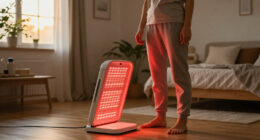
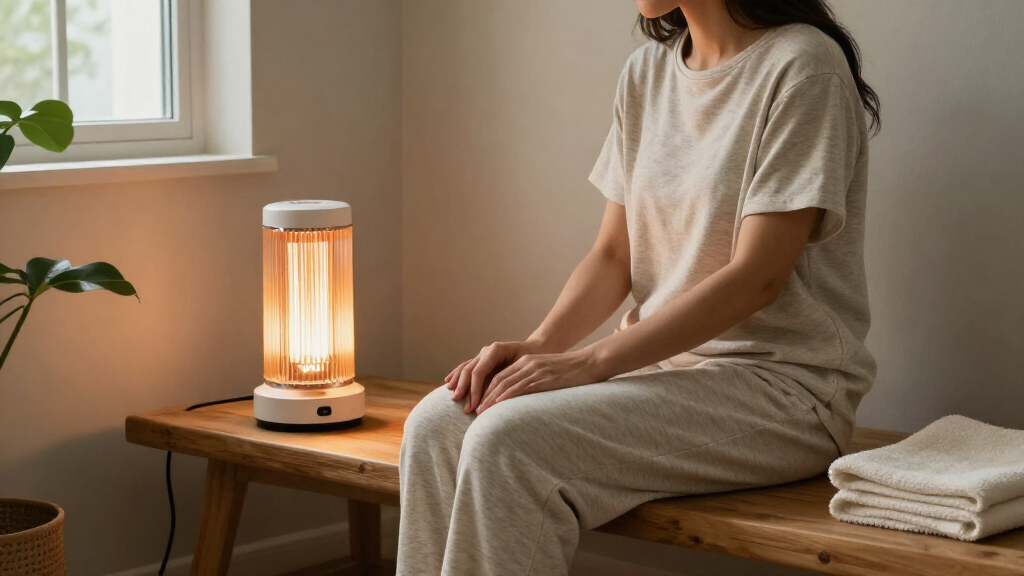
An infrared wellness heat lamp is a device that warms your body using infrared radiation, often with a glowing incandescent bulb. Infrared is invisible electromagnetic energy; when your skin and nearby tissues absorb it, they warm up. In ordinary use, the result feels less like a mysterious treatment and more like sitting near a small, focused heater.
The phrase is broad. It usually refers to a lamp directed at one area, but sellers may also use similar wording for infrared panels, sauna blankets, or enclosed saunas. Those products differ in how much of your body they heat, how they deliver energy, and what evidence applies to them.
Imagine you spend the afternoon painting and your upper back feels tight. A lamp aimed according to its instructions may make the area feel pleasantly warm, like sunlight through a window on a cold morning. That sensation can be comforting, but it does not establish that the device has reached deep structures or changed the underlying cause of the tightness.
Labels such as near-, mid-, and far-infrared describe wavelength ranges. The label alone does not tell you whether a lamp works better or is safer; power, distance, session length, and construction also matter. Check the actual product directions rather than treating “infrared” as a standard dose.
Products Worth Considering

Therabody Theragun Sense 2nd Generation Percussion Massage Gun, Black

Levoit Core 300S-P Smart WiFi Air Purifier for Home and Pets

Oura Ring 5 Smart Ring, Silver, Size 9
As an affiliate, we earn on qualifying purchases.
What relief you may get—and what the evidence does not promise
Infrared wellness heat lamps may provide temporary comfort by warming a treated area, which can help some people feel less stiff or tense. Warming skin can increase local blood flow, and the heat may feel relaxing. Those effects are not the same as treating a disease or improving circulation throughout your whole body.
Think of someone easing into a warm room after carrying groceries through winter rain. Their shoulders may loosen as they warm up; the change feels real, even if it does not explain why the muscles felt tight in the first place. A heat lamp may offer a similar short-term comfort for some users, but results vary and research on a particular consumer lamp may be limited.
Be careful when sellers borrow evidence from other technologies. Studies of infrared saunas, lasers, or LED photobiomodulation do not automatically prove that an incandescent heat lamp produces the same result. The device and treatment conditions matter.
Claims about detoxification, substantial fat loss, immunity, or disease treatment are not established benefits of a heat lamp. Sweating is mainly your body’s way of cooling itself; it does not show that toxins have been meaningfully removed. A warm session may feel good, but comfort is not proof of a cure.
How to use a heat lamp more safely at home
To use an infrared heat lamp more safely, follow the exact instructions for your model and stop if your skin becomes painful, unusually red, numb, or blistered. There is no universal safe distance or session length for every device, because heat output and design vary. A setting that feels comfortable at first can still become too hot if you stay in place too long.
- Read the manual first. Check the stated distance, exposure time, placement, and any eye-protection advice before switching on the lamp.
- Set up a stable, clear space. Keep the lamp away from water, curtains, bedding, and other flammable materials, and place it where children or pets cannot knock it over.
- Protect your eyes. Do not stare at the bulb or point it toward your eyes. Use protection if the manufacturer or a clinician recommends it.
- Stay awake and check your skin. Never fall asleep under a lamp. Stop if your skin hurts or changes in a way that concerns you.
- Ask a health professional when heat sensitivity may be affected. Reduced sensation, impaired circulation, diabetes-related nerve problems, fragile skin, pregnancy, and young age call for added care.
For example, if you are using a lamp while reading beside a sofa, make sure the stand cannot tip and that you can easily move away. Do not extend the session simply because the warmth feels pleasant. Persistent or severe symptoms deserve medical advice rather than repeated heat sessions that delay an evaluation.
How a lamp differs from a sauna or light-therapy device
A heat lamp generally warms a localized area, while an infrared sauna warms a much larger part of the body in an enclosed setting. LED or laser light devices also differ from ordinary heat lamps, even when product listings group them under broad wellness language. Evidence about one device should not be used as proof about another.
Picture the difference between holding your hands near a small heater and sitting in a heated room. Both involve warmth, but the amount of exposed skin, the environment, and the exposure conditions change. A compact lamp aimed at your shoulder is not interchangeable with a sauna blanket wrapped around your body.
| Device | What it generally warms | What to check |
|---|---|---|
| Infrared heat lamp | One nearby area, such as a shoulder or back | Distance, timing, bulb type, and placement directions |
| Infrared sauna or blanket | A much larger part of the body | Whole-body heat guidance and device-specific warnings |
| LED or laser light device | Light exposure using a different source and purpose | Specific device, intended use, and evidence for that protocol |
When you see a claim that “infrared” supports a particular outcome, ask which exact device researchers studied. A result from a controlled light-therapy protocol does not establish that a household heat lamp will produce the same effect.
How to judge product claims before you buy
A credible product description explains what the device is designed to do and gives clear instructions, warnings, and replacement guidance. Be cautious when a listing leans on phrases such as “deep penetrating,” “cellular repair,” or “detox” without explaining the device, evidence, or limits. Marketing language is a claim to check, not proof of a health benefit.
Suppose two lamps look similar online. One gives a clear manual, stable-base details, and a specific intended use; the other promises to burn fat and remove toxins but provides vague directions. The first offers more useful information, even if neither product has been shown to treat a medical condition.
- Look for clear safety directions on distance, duration, placement, and eye exposure.
- Check the intended use. “Wellness” does not automatically mean the product has been evaluated as a medical treatment.
- Ask what evidence matches the device. A study about a sauna, laser, or LED device may not apply to a lamp.
- Prefer specific, limited claims over guaranteed results or promises to treat multiple diseases.
- Check construction and upkeep, including stability, bulb replacement information, and warnings about heat.
Online interest in compact lamps, panels, sauna blankets, and combination devices keeps growing, and sellers often place them in the same wellness category. For you as a buyer, the practical question is not which label sounds most advanced. It is whether the device’s purpose, instructions, and evidence match what you actually want from it.
When warmth is not enough to handle the problem
A lamp is not a substitute for a medical assessment when pain is severe, worsening, unexplained, or persistent. Heat may ease discomfort for a while, but temporary relief does not tell you what caused the symptom. That distinction matters if you are using warmth to manage a new injury or a problem that keeps returning.
For instance, if your knee feels stiff after a long walk and then settles, warmth may feel soothing. If the pain is getting worse, the area is swollen, or your movement is limited, repeatedly warming it without asking for guidance could delay the right next step. The same caution applies to skin conditions or an injury that has just occurred.
Heat also deserves extra care if you cannot reliably feel when it becomes too hot. Reduced sensation or circulation problems can make it harder to notice skin injury early. A clinician can help you decide whether heat is appropriate for your circumstances and what precautions fit your health.
Use a heat lamp for warmth, not as a reason to postpone care. If a symptom persists or raises concern, talk with a qualified health professional.
The aim is not to fear a warm lamp. It is to keep a comforting tool in its proper role: one possible way to feel temporary relief, with safety instructions followed and medical decisions left to qualified professionals.
Frequently Asked Questions
Is an infrared heat lamp the same as an infrared sauna?
No. A lamp generally heats a localized area, while a sauna warms a much larger part of your body in an enclosed space. Their designs and exposure conditions differ, so findings about one do not automatically apply to the other.
Can an infrared heat lamp help with sore muscles?
It may provide temporary comfort for some people, much like other forms of warmth can ease stiffness. It does not diagnose or treat the cause of pain, so ask a health professional about severe, worsening, new, or persistent symptoms.
How long and how far away should I use one?
There is no single distance or session time that fits every lamp. Follow the exact manufacturer instructions, since heat output and design vary, and stop if your skin becomes painful, unusually red, numb, or blistered.
Can an infrared lamp detox my body or help me lose weight?
A heat lamp is not an established detox or weight-loss treatment. Sweating is mainly a cooling response, and temporary fluid loss is not the same as losing body fat or proving that toxins have been removed.
What should I look for when buying an infrared wellness heat lamp?
Look for clear instructions, safety warnings, stable construction, and bulb replacement guidance. Be skeptical of guaranteed results or broad disease-treatment claims, and check whether any evidence cited actually concerns that type of lamp rather than a sauna or another light device.
Conclusion
Remember the simplest distinction: infrared heat is a way to deliver warmth, not a shortcut to detoxification, weight loss, or disease treatment. If you try a lamp for comfort, choose a clearly described product, follow its exact directions, and pay attention to how your skin responds.
A warm patch of light can feel like a little pocket of sunshine on a cold day. Enjoy the warmth for what it is—and seek professional advice when your symptoms need more than warmth.