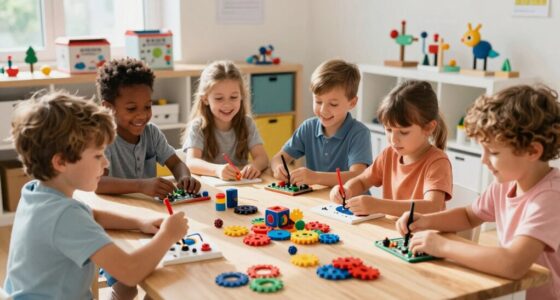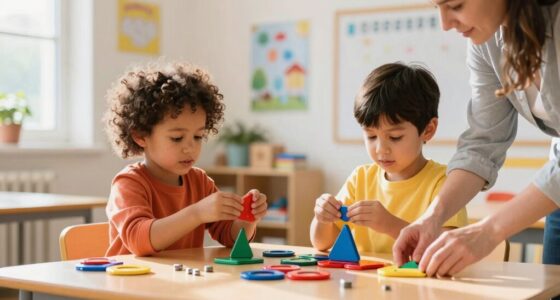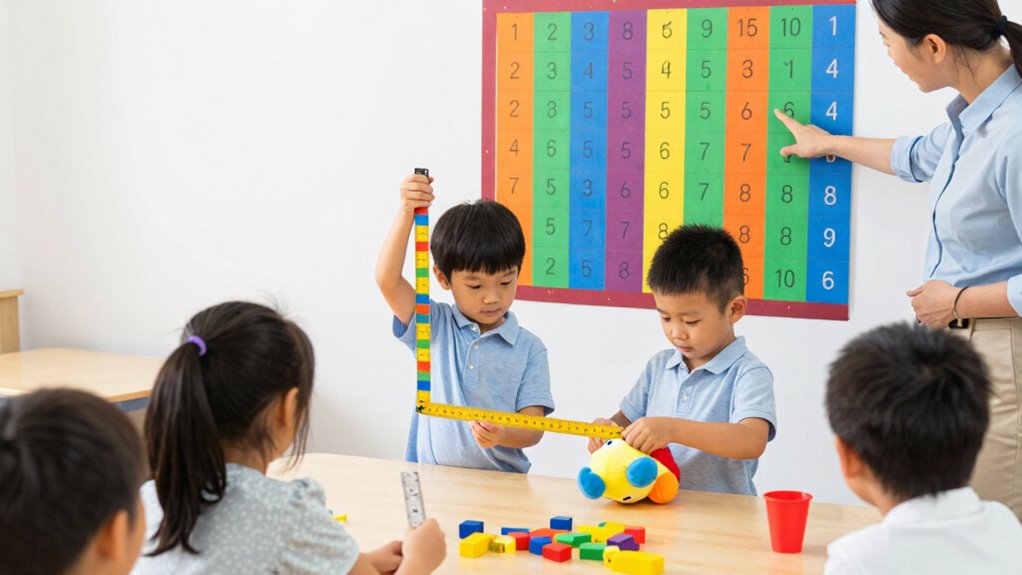

You can make measurement fun for early learners with simple games using household objects like pencils, spoons, or books to compare sizes and lengths. Encourage hands-on activities such as estimating and then measuring with rulers or cups, and ask guided questions to teach unit conversions. These games boost engagement and help kids understand volume, length, and size practically. Keep exploring more ideas to turn everyday moments into educational adventures that develop critical thinking and measurement skills.
Key Takeaways
- Use household objects like pencils and spoons for fun comparison and measurement activities.
- Incorporate measurement tools such as rulers or measuring cups for hands-on learning.
- Create games where children estimate and then measure to develop accuracy skills.
- Engage children with real-world tasks like measuring ingredients or toy sizes.
- Customize activities around interests, like measuring dog breeds or home projects, for meaningful learning.

Measurement games are a fun and effective way to help children grasp basic concepts of size, length, and volume. When you introduce measurement through play, kids become more engaged and enthusiastic to learn. These games are simple to set up and can be customized to fit your child’s interests, making learning both enjoyable and meaningful. One of the key skills children develop during these activities is understanding unit conversion, which is fundamental for making sense of different measurement systems. For example, you can show them how inches relate to centimeters, helping them see that measurements can be transformed from one unit to another with ease. Using measurement tools like rulers, measuring cups, and scales, children get hands-on experience that cements their understanding of size and quantity. These tools act as visual and tactile aids, making abstract concepts more concrete.
You can start with a basic game where your child measures various objects around the house, such as a pencil, a book, or a spoon, using a ruler or tape measure. Encourage them to compare the lengths and note the differences. Once they’re comfortable with this, introduce the idea of unit conversion by asking questions like, “If this pencil is 8 inches long, how many centimeters is that?” Show them how to use measurement tools to find the answer, guiding them through converting inches to centimeters. This not only builds their understanding of different units but also develops their problem-solving skills. Additionally, incorporating concepts from dog breeds, such as the importance of precise measurements in health and training routines, can help illustrate the practical applications of measurement in everyday life. Moreover, understanding self-sufficiency techniques can help children appreciate the importance of accurate measurements in preparing food or growing a garden. Recognizing how accurate measurements are essential in home improvement projects can also add real-world relevance to their learning. Furthermore, emphasizing the role of precise measurements in luxury lifestyle contexts can inspire children to see the significance of accuracy in different areas of life. Developing a sense of measurement accuracy can also foster attention to detail, which is a valuable skill across many disciplines.
Another effective game involves measuring liquids with measuring cups. Fill different containers with water or juice and have your child estimate the volume before measuring it precisely. Afterward, ask them to compare the amounts and discuss which container holds more or less. This activity helps them grasp the concept of volume and reinforces their ability to use measurement tools accurately. To make it more fun, you can create a game where they record their measurements and compare them over time, noticing how things change with different objects or liquids. These activities encourage critical thinking about measurement and make the concept of unit conversion more intuitive.
As an affiliate, we earn on qualifying purchases.
Frequently Asked Questions
How Can Measurement Games Be Adapted for Different Age Groups?
You can adapt measurement games for different age groups by adjusting the difficulty level and using age-appropriate tools. For younger kids, focus on basic measuring accuracy with simple tools like rulers or cups. As they grow, introduce more complex tools and tasks that challenge their understanding of measurement concepts. This approach helps guarantee the games remain engaging and educational, fostering a solid foundation in measurement skills at every age.
What Materials Are Needed to Create Measurement Games at Home?
To create measurement games at home, gather craft supplies like rulers, measuring tapes, paper, and markers. You can make activity ideas such as measuring objects around your house or comparing lengths with friends. Use tape to mark measurements on surfaces or create simple charts. These materials help kids practice measuring skills while having fun, turning everyday items into engaging, educational activities that boost their understanding of size and comparison.
How Do Measurement Games Support Early Childhood Development?
Measurement games act as a bridge to better measurement accuracy and cognitive development, like a ladder climbing to new skills. They help you see how children learn to compare sizes, understand units, and develop problem-solving abilities. These activities turn abstract concepts into tangible experiences, engaging young minds in hands-on exploration. By playing, children sharpen their thinking, improve their understanding of measurements, and build confidence in their growing abilities.
Are There Any Online Resources for Measurement Game Ideas?
Yes, you can find online resources for measurement game ideas that incorporate measurement tools and offer game variations. Websites like Pinterest, Teachers Pay Teachers, and educational blogs provide free or low-cost activities designed for early learners. These resources often include step-by-step instructions, printable tools, and different game variations to keep children engaged while they learn about measurement concepts. Exploring these sites will give you plenty of creative ideas to try.
How Can Parents Assess a Child’s Understanding During These Games?
You can assess your child’s understanding during measurement games by observing their engagement and responses. Use assessment strategies like asking open-ended questions to identify understanding indicators, such as whether they can compare lengths or explain their reasoning. Watch for moments where they confidently choose tools or correct mistakes, revealing their grasp of concepts. These cues help you gauge their progress, turning playful learning into meaningful insight.
children's measuring cups and spoons
As an affiliate, we earn on qualifying purchases.
As an affiliate, we earn on qualifying purchases.
Conclusion
Think of these measurement games as the seeds you plant in your child’s early learning garden. With your guidance, they’ll grow into tall, strong trees of understanding, rooted in fun and curiosity. Just like tending to a garden, your involvement nurtures confidence and joy in learning. Before you know it, your little explorer will be reaching new heights, measuring the world with a smile, ready to discover endless adventures ahead.
early learning measurement games
As an affiliate, we earn on qualifying purchases.
As an affiliate, we earn on qualifying purchases.
kids length and volume measurement tools
As an affiliate, we earn on qualifying purchases.
As an affiliate, we earn on qualifying purchases.