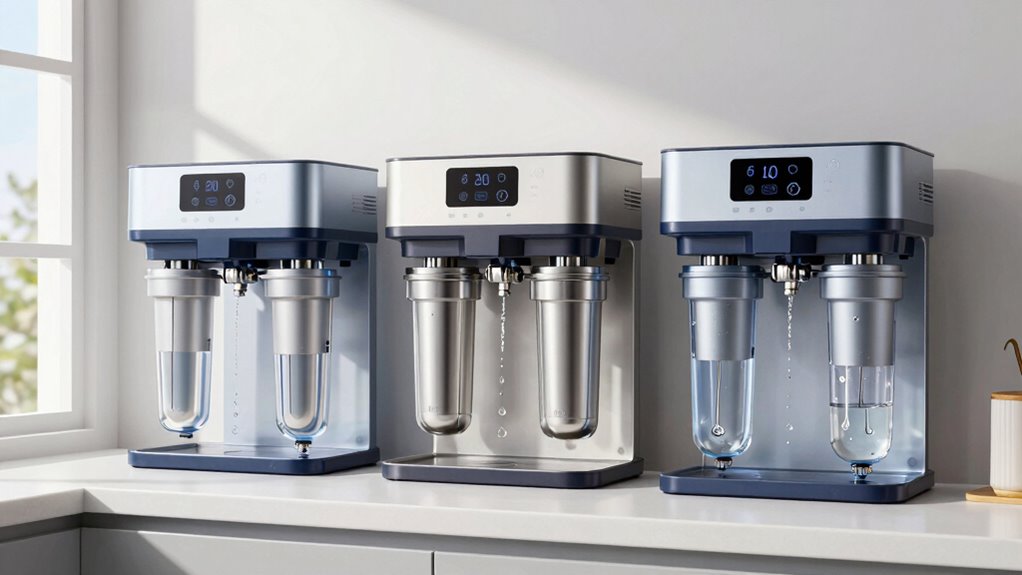

Choosing a water filter system for well water starts with the water itself: sediment and odors call for a different setup than dissolved metals or other contaminants. Among these five options, the Express Water 3-Stage Ultimate Protection stands out for its stainless steel build, gauges, and stated heavy-metal and scale protection; the WF3-01 lists the broadest range of contaminants, including VOCs; and the 0.5-micron nine-filter system suits buyers who mainly want sediment, chlorine, and odor reduction with spare cartridges included.

Get health and wellness essentials delivered free with Prime
- Fast, free delivery on millions of items
- Prime Video, Amazon Music and more included
- Member-only deals all year
Those differences matter more than a long list of filtration claims. These systems do not all address the same risks, and several explicitly do not reduce TDS. I rank them by how clearly their stated features fit common well-water needs, while weighing flow, monitoring, installation footprint, and replacement demands. A lab test of your well water should guide the final choice; none of these general-purpose systems should be treated as a substitute for testing or a verified treatment plan for a specific contaminant.
Key Takeaways
- For stated heavy-metal and scale protection plus a stainless steel frame, the Express Water system is the strongest all-around fit, but it is bulky and does not reduce TDS.
- The WF3-01 lists the broadest contaminant range in this group, including VOCs and several heavy metals, while its 180-day service schedule can mean frequent cartridge upkeep.
- The transparent 0.5-micron system makes visual cartridge checks easy and includes three filter sets, but its stated targets are sediment, chlorine, and odors rather than dissolved contaminants.
- The two other nine-filter kits offer a similar sediment-and-odor approach; the B0GX5512V1 adds a bypass and dual shut-off valves, while the B0GWHPSG4P emphasizes compact placement.
- A 15–17 GPM rating and whole-house design do not prove suitability for every well: test the water and check household demand, pressure, and treatment requirements first.
| Express Water Whole House Water Filter System, 3-Stage Ultimate Protection |  | Best Overall for a More Robust Whole-House Setup | Stages and media: 3-stage; activated carbon, KDF, and polyphosphate | Maximum flow: 17 GPM | Capacity: Up to 100,000 gallons | VIEW ON AMAZON | See Our Full Breakdown |
| WF3-01 3-Stage Whole House Water Filtration System – Reduces Heavy Metals, Chlorine, Sediment, Odor & VOCs | 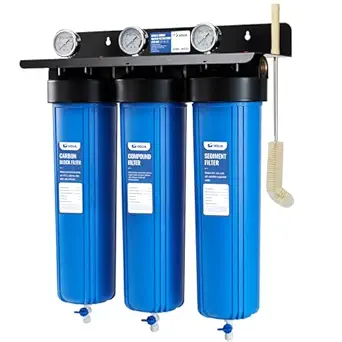 | Best for a Broad Listed Contaminant Range | Stages: 3 | Filter size: 20 × 5.5 inches each | Overall dimensions: 31 H × 23 W × 8 D inches | VIEW ON AMAZON | See Our Full Breakdown |
| Whole House Water Filter System with 9 Filters, 3-Stage, 0.5 Micron Filtration |  | Best for Visible Cartridge Checks and Spare Filters | Stages: 3 | Filter types: PP sediment, GAC carbon, CTO carbon block | Maximum flow: 15 GPM | VIEW ON AMAZON | See Our Full Breakdown |
| Whole House Water Filter System for Well Water, 3-Stage, 2-Year Filter Supply |  | Best for Easier Cartridge Changes | Stages: 3 | Filter sets: 3 sets; 9 filters total | Maximum flow: 15 GPM | VIEW ON AMAZON | See Our Full Breakdown |
| 3-Stage Whole House Water Filter System with 9 Filters, 0.5 Micron |  | Best Compact Basic Filter Kit | Stages: 3 | Filter types: PP, GAC, and CTO | Filter sets included: 3 sets; 9 filters total | VIEW ON AMAZON | See Our Full Breakdown |
| water filter systems for well water | TDS reduction | Stages | Maximum flow |
|---|---|---|---|
| Express Water Whole House Wate | Does not reduce TDS | — | 17 GPM |
| WF3-01 3-Stage Whole House Wat | — | 3 | — |
| Whole House Water Filter Syste | Does not reduce TDS | 3 | 15 GPM |
| Whole House Water Filter Syste | Does not reduce TDS | 3 | 15 GPM |
| 3-Stage Whole House Water Filt | Does not reduce TDS | 3 | — |
More Details on Our Top Picks
Express Water Whole House Water Filter System, 3-Stage Ultimate Protection
I put the Express Water system first because its stated scope reaches beyond basic sediment and odor treatment: it uses activated carbon, KDF, and polyphosphate and is described as reducing chlorine, heavy metals, and scale build-up. For a well owner whose test results point to those concerns, that broader positioning makes it a more compelling starting point than the PP/GAC/CTO systems below, which focus on sediment, chlorine, and odors. The 17 GPM maximum flow rate is also the highest listed here, giving it a modest advantage for homes with several fixtures drawing water at once.
Its practical difference is the stainless steel construction and pressure gauges. The gauges provide a way to watch system pressure and may help flag a change that calls for inspection; the build is more substantial than the plastic housings on the nine-filter kits. That comes with a real installation cost in space and handling: at 63 pounds and roughly 29 by 8.5 by 30 inches, this is not the compact choice for a tight utility nook.
I would not read “ultimate protection” as a promise to solve every well-water issue. The listing says it does not reduce TDS, and its filter life is given as six months in one spec and up to six to twelve months or 100,000 gallons in the description. That variation makes a water test and cartridge schedule important. Compared with the WF3-01, it has a listed 17 GPM rate but does not explicitly name VOC reduction; compared with the simpler kits, it offers a broader stated treatment approach but needs more room and a careful check of replacement media.
Pros:- Lists reduction of chlorine and heavy metals, with polyphosphate for scale-related treatment.
- Stainless steel construction and pressure gauges support monitoring and a sturdier installation.
- 17 GPM maximum flow is the highest stated rate among these five systems.
- Capacity is listed as up to 100,000 gallons.
Cons:- Large, heavy unit needs a suitable installation area and may take more effort to position.
- Does not reduce TDS, and listed filter-life guidance varies between six months and six to twelve months.
- The stated treatment claims should be matched to a water test and verified performance documentation.
Best for: Well owners whose test results show concerns such as chlorine, certain heavy metals, or scale, and who have room for a sturdier whole-house unit.
Not ideal for: Buyers who need TDS reduction, have limited installation space, or want a small plastic-housing kit with several spare filter sets included.
- Stages and media:3-stage; activated carbon, KDF, and polyphosphate
- Maximum flow:17 GPM
- Capacity:Up to 100,000 gallons
- Filter life:Listed as 6 months; description states 6–12 months
- Dimensions:29 × 8.5 × 30 inches
- Weight:63 pounds
- Operating pressure:20–80 psi
- TDS reduction:Does not reduce TDS
Our verdict“My leading pick for broader stated whole-house treatment, provided your test results match its claims and you have space for its heavy frame.”
WF3-01 3-Stage Whole House Water Filtration System – Reduces Heavy Metals, Chlorine, Sediment, Odor & VOCs
The WF3-01 earns its place near the top because its stated target list is the broadest here: sediment, chlorine, odor, VOCs, and several heavy metals, including lead, mercury, arsenic, cadmium, and chromium. That makes it a more relevant candidate than the 0.5-micron carbon-and-sediment kits when a lab report identifies contaminants beyond visible particles or taste issues. I would still verify the exact reduction claims and cartridge certifications before buying; a product description alone is not proof that a given contaminant is treated to the level your household needs.
Monitoring and service details are another advantage. It includes multiple pressure gauges, a 180-day countdown timer, pressure relief and drain valves, plus a cleaning brush. Those additions make maintenance more structured than on the basic systems, which generally offer spare filters or shut-off hardware but fewer explicit monitoring aids. Its three 20-by-5.5-inch filters and 31-inch height, however, call for a more deliberate installation plan than the compact B0GWHPSG4P.
The clearest drawback is upkeep: the service timer points to roughly six-month cartridge changes, and the supplied details do not give a flow rate or capacity to compare with Express Water’s 17 GPM and 100,000-gallon figures. It also lacks a stated TDS reduction claim. I’d choose it over the Express Water unit when VOC coverage is a priority in the product’s verified documentation; I’d choose Express Water when its listed flow and stainless frame matter more and its own treatment claims fit the test results.
Pros:- Lists reduction of VOCs and several named heavy metals, along with sediment, chlorine, and odors.
- Multiple gauges and a 180-day timer make maintenance cues more visible.
- Includes pressure relief and drain valves, pipe adapters, and a housing cleaning brush.
- Can be bracket-mounted or installed freestanding.
Cons:- Cartridges are listed for replacement roughly every 180 days.
- No maximum flow rate or capacity is supplied in the provided specifications.
- The 31-inch-tall system needs more installation planning than the compact filter kits.
Best for: Households whose water test identifies heavy metals or VOCs and whose owners want gauges, a service timer, and included service hardware.
Not ideal for: Buyers seeking infrequent maintenance, a small cabinet-friendly filter, or a clearly stated flow-rate and capacity figure.
- Stages:3
- Filter size:20 × 5.5 inches each
- Overall dimensions:31 H × 23 W × 8 D inches
- Mounting:Bracket-mounted or freestanding
- Monitoring:Multiple pressure gauges and 180-day service timer
- Valves:Pressure relief and drain valves
- Pipe adapters:3/4-inch NPT or 1-inch NPT
- Stated targets:Heavy metals, VOCs, chlorine, sediment, and odor
Our verdict“My pick for buyers prioritizing a broad stated contaminant list and built-in maintenance cues, subject to verifying its claims against the well-water test.”
Whole House Water Filter System with 9 Filters, 3-Stage, 0.5 Micron Filtration
This system is an easy-to-understand choice for a household focused on sediment, rust, chlorine, and odors. Its PP sediment, GAC carbon, and CTO carbon-block stages use a stated 0.5-micron filtration rating, and its transparent housing lets an owner see the cartridges rather than relying solely on a calendar. That can be useful in a well-water setting where sediment levels may change, though visual appearance is not a substitute for testing or a reliable measurement of cartridge performance.
The package includes three full sets of filters—nine cartridges total—which separates it from the Express Water and WF3-01 systems, whose supplied details do not promise several replacement sets. It also lists 15 GPM and 3/4-inch connections, making it a plausible match for small to medium households with standard plumbing. Compared with the nearly similar B0GWHPSG4P, this model supplies the more specific micron rating, flow figure, and transparent housing; the other kit instead highlights built-in shut-off valves and compact placement.
The limits are substantial if your well has dissolved contaminants. This system says it does not reduce TDS, and the supplied claims center on sediment, chlorine, and odors rather than heavy metals or VOCs. Its transparent plastic housing may also be less reassuring to buyers who prefer the heavier stainless steel build of Express Water. I would select it for routine particle and taste improvement, not as a broad contaminant solution without test-matched evidence.
Pros:- Three complete PP, GAC, and CTO filter sets are included.
- Transparent housings make cartridge condition easier to inspect visually.
- Stated 0.5-micron filtration and 15 GPM maximum flow.
- Targets sediment, rust, chlorine, and odors.
Cons:- Does not reduce TDS and does not list a broad dissolved-contaminant treatment claim.
- Requires basic plumbing ability for installation.
- Transparent plastic housing is less substantial than the stainless steel Express Water frame.
Best for: Small to medium households that want visible cartridge monitoring, a stated 0.5-micron rating, and replacement sets included.
Not ideal for: Well owners seeking stated heavy-metal, VOC, or TDS reduction, or anyone who prefers a metal-bodied system.
- Stages:3
- Filter types:PP sediment, GAC carbon, CTO carbon block
- Maximum flow:15 GPM
- Filter sets included:3 sets; 9 filters total
- Housing:Transparent plastic
- Connections:3/4 inch
- TDS reduction:Does not reduce TDS
Our verdict“My choice for a straightforward sediment-and-odor setup with visible housings and spare cartridges, not for well-water problems beyond its stated scope.”
Whole House Water Filter System for Well Water, 3-Stage, 2-Year Filter Supply
The most buyer-friendly feature of this system is not a special contaminant claim; it is the built-in bypass and dual shut-off valves. Those details can make filter servicing less disruptive than on a basic setup, especially for a homeowner who wants to isolate the unit during a cartridge change. It also includes three full sets of filters, with PP sediment, GAC carbon, and CTO carbon block stages described as reducing sediment, chlorine, and odors while preserving natural minerals.
For that reason, I see it as a practical alternative to the transparent B0GCGKP3J1 rather than a more powerful treatment system. Both list 15 GPM flow and nine filters across three sets; this model’s stronger distinction is its service hardware and compact dimensions of 14 by 13 by 10 inches. The description says it can fit under a sink or in a utility room, though its whole-house role and the listed installation type should be checked against the actual plumbing layout before purchase.
The product information needs careful interpretation. It lists a six-month filter life cycle alongside a two-year filter supply, so “two years” refers to the quantity supplied, not necessarily a maintenance-free interval. It also says TDS remains unchanged and provides no stated heavy-metal or VOC reduction. The listed 10,000-gallon capacity and maximum TDS of 1,000 ppm are not replacements for contaminant-specific performance data. I’d favor it over B0GWHPSG4P if easier isolation during maintenance is the priority; I’d skip it if your well test calls for treatment beyond the listed particle, chlorine, and odor targets.
Pros:- Built-in bypass and dual shut-off valves support easier filter servicing.
- Includes three full sets of filter cartridges.
- Lists 15 GPM maximum flow and standard 3/4-inch plumbing fit.
- Targets sediment, chlorine, and odors while retaining natural minerals.
Cons:- Does not reduce TDS or list treatment for heavy metals and VOCs.
- Six-month filter-life guidance means a two-year supply still involves regular changes.
- 15 GPM may be limiting in homes with high simultaneous water demand.
Best for: Homeowners who want a basic three-stage filter with spare cartridges and valves that simplify isolation during service.
Not ideal for: Households that need TDS reduction, verified heavy-metal or VOC treatment, or a flow rate above the listed 15 GPM maximum.
- Stages:3
- Filter sets:3 sets; 9 filters total
- Maximum flow:15 GPM
- Capacity:10,000 gallons
- Filter life cycle:6 months
- Dimensions:14 × 13 × 10 inches
- Connections:Standard 3/4-inch plumbing
- TDS reduction:Does not reduce TDS
Our verdict“My maintenance-friendly pick for ordinary sediment, chlorine, and odor concerns, with the reminder that its spare filters do not broaden its treatment scope.”
3-Stage Whole House Water Filter System with 9 Filters, 0.5 Micron
This is the most compact-leaning option in the group, described as suitable for an under-sink area or utility room. It uses three stages—PP, GAC, and CTO—and is aimed at improving water affected by sediment, chlorine, and odors. Three complete sets provide nine filters, so it shares the practical replacement-stock advantage of B0GCGKP3J1 without the same supplied detail about a transparent housing or a stated flow rate.
The product’s built-in shut-off valves make routine filter changes more manageable, giving it some overlap with the bypass-equipped B0GX5512V1. Its role is still narrower: B0GX5512V1 specifies a bypass and dual shut-off arrangement, while this model’s distinguishing appeal is a compact format and 0.5-micron claim. Compared with B0GCGKP3J1, it provides less information for judging flow and housing visibility, so I would not rank it ahead of that kit for buyers who want measurable specifications at a glance.
The central limitation is treatment scope. This system does not reduce TDS and is described for sediment, chlorine, and odor rather than dissolved metals or VOCs. Its stated filter life is 1.5 to 2 years, while the package includes three sets; actual replacement timing should follow the manufacturer’s cartridge directions and your water conditions. Buyers with a lab report showing contaminants outside the stated targets should look to a treatment method verified for those specific findings rather than expecting this compact kit to solve them.
Pros:- Compact format is described as fitting under sinks or in utility rooms.
- Includes three filter sets, nine cartridges total.
- Three PP, GAC, and CTO stages target sediment, chlorine, and odors.
- Built-in shut-off valves support cartridge changes.
Cons:- Does not reduce TDS and has a limited stated contaminant scope.
- No maximum flow rate is supplied in the provided specifications.
- Compared with B0GCGKP3J1, the details do not specify transparent housing for visual checks.
Best for: Households with limited installation space that want a basic sediment, chlorine, and odor filter with spare cartridges.
Not ideal for: Well owners who need stated treatment for heavy metals, VOCs, TDS, or a clearly documented flow rate.
- Stages:3
- Filter types:PP, GAC, and CTO
- Filter sets included:3 sets; 9 filters total
- Stated filter life:1.5–2 years
- Housing:Plastic
- Plumbing size:3/4 inch
- TDS reduction:Does not reduce TDS
Our verdict“My compact basic-kit pick when space and included cartridges matter more than broader contaminant claims or detailed flow specifications.”

How We Picked
I compared the five systems as whole-house options for well-water households, not as interchangeable filtration kits. The ranking gives more weight to the stated contaminant range and practical monitoring than to the number of cartridges included. Well water varies by location and may contain issues that a sediment-and-carbon system does not address, so I distinguish clearly between products that list heavy-metal or VOC reduction and those described mainly for sediment, chlorine, and odor.
I also considered flow rate, plumbing fit, maintenance cues, and installation needs. A gauge or service timer can help an owner notice when maintenance is due, while a transparent housing offers a simpler visual check. Extra filter sets may reduce the need to source replacements right away, but they do not erase the need for regular changes. Product details supplied for this comparison include some conflicting or incomplete claims, so I avoid treating marketing statements as independent certification. Before buying, match the system’s documented performance to a recent water test and confirm cartridge availability, pressure limits, and installation requirements.
Factors to Consider When Choosing Water Filter Systems For Well Water
I would choose a well-water filter only after identifying what is in the water and what needs treatment. These systems differ in stated targets, servicing features, and footprint; no single feature makes one suitable for every private well.Start with a well-water test
Test untreated well water through a qualified laboratory and review the results with a water-treatment professional where needed. Sediment, metals, VOCs, bacteria, hardness, and dissolved minerals are different problems, and a three-stage label does not tell you which ones a system can handle. In this lineup, the three PP/GAC/CTO kits mainly claim sediment, chlorine, and odor reduction. Express Water and the WF3-01 list broader contaminant targets, but I would still ask for performance documentation that matches the contaminant and concentration in your report.
Match the filter media to the problem
PP sediment filters are intended to catch particles, while carbon media are commonly used to address chlorine, taste, and odor. Those functions do not automatically remove dissolved metals or reduce total dissolved solids. Do not use a 0.5-micron figure as a universal safety claim: it describes a particle-size rating, not proof of reduction for every chemical or biological contaminant. If a test identifies a specific risk, check that the exact cartridge and system have suitable, independently verified reduction data for it.
Compare flow and household demand
Express Water lists a maximum of 17 GPM, while the transparent nine-filter kit and B0GX5512V1 each list 15 GPM. The B0GWHPSG4P and WF3-01 do not provide a comparable flow figure in the supplied details. Maximum flow alone does not predict performance at your home’s pressure or with several fixtures running. Check your plumbing size, well pump output, pressure range, and expected peak demand; a system that restricts flow can affect showers and appliances even if its filtration claims look suitable.
Plan for cartridge changes and installation
Included spare filters are useful, but they do not mean the system can run for years without service. B0GCGKP3J1, B0GX5512V1, and B0GWHPSG4P each include three sets of cartridges; B0GX5512V1 lists a six-month filter cycle, while B0GWHPSG4P states 1.5–2 years. The WF3-01 adds a 180-day timer and gauges, and B0GX5512V1 includes bypass and dual shut-off valves. Check the replacement schedule, cartridge availability, space for changing housings, and whether installation needs a plumber before choosing.
Understand what TDS claims do not tell you
Several systems explicitly say they do not reduce TDS. TDS is a broad measure of dissolved material; it does not identify which substances are present or establish whether water is safe. If a lab report points to a dissolved contaminant or a mineral issue, ask for a treatment method designed and documented for that specific result. A whole-house sediment-and-carbon filter may still improve some water qualities, but it should not be treated as a substitute for targeted treatment.
Check installation fit before ordering
Confirm whether the system is intended for the main incoming line, the available clearance, and the plumbing connections. Most of the kits list 3/4-inch plumbing, while the WF3-01 supplies adapters for 3/4-inch or 1-inch NPT. Express Water is a 63-pound freestanding unit; the transparent kit needs basic plumbing skills; and the compact models still require access to change cartridges. Have a qualified installer review the setup if you are unsure about pressure, bypass routing, or protecting the plumbing from leaks.
Frequently Asked Questions
What kind of water filter is best for well water?
There is no single best filter for every well because water composition varies. I would begin with a laboratory test, then match the system’s verified reduction claims to the results. The sediment-and-carbon kits here target particles, chlorine, and odors, while Express Water and the WF3-01 list broader targets such as heavy metals or VOCs. Those claims still need to be checked against the exact contaminants in your water.
Do these whole-house systems remove bacteria from well water?
The supplied product details do not establish that any of these systems disinfects water or reliably removes bacteria, viruses, or parasites. A 0.5-micron rating should not be treated as proof of microbial safety. If testing finds a biological concern, consult a qualified water professional about an appropriate treatment method, such as a properly specified disinfection system, and retest after installation.
Will a whole-house filter reduce TDS?
Several products in this comparison explicitly state that they do not reduce TDS, and the remaining descriptions do not provide a clear TDS-reduction claim. TDS is a general measurement of dissolved material, not a diagnosis of which substances are present. If reducing a particular dissolved contaminant is your goal, use test results to select treatment with verified performance for that substance rather than relying on a general-purpose sediment filter.
How often should I replace the filters?
Follow the cartridge maker’s schedule and account for actual water use and well conditions. The WF3-01 lists a 180-day service timer, B0GX5512V1 gives a six-month filter cycle, and B0GWHPSG4P states 1.5–2 years; the Express Water life guidance varies between six months and six to twelve months. The systems with three included sets provide replacement stock, not a guarantee that each set lasts a fixed period in every home.
Should I install a whole-house filter myself?
That depends on your plumbing experience, the system’s placement, and the condition of the main water line. Some listings describe easier servicing with valves, but installation still requires a leak-safe connection and compatibility with your plumbing and water pressure. I would hire a qualified plumber if you are uncertain about pipe sizing, bypass routing, pressure limits, or how to protect the well system and household plumbing.
Conclusion
For a household whose lab results match the listed heavy-metal or scale targets and that has room for a substantial unit, I would start with the Express Water system. If VOCs and named heavy metals are the priority, the WF3-01 offers the broadest stated list and the clearest maintenance cues, but plan for its six-month service cycle and verify the performance documentation. For basic sediment, chlorine, and odor concerns, choose the transparent B0GCGKP3J1 for visible housings and spare filters, or the B0GX5512V1 if bypass and shut-off valves matter more. Pick the B0GWHPSG4P when compact placement is the main need. In every case, let a recent well-water test—not a broad “whole house” label—decide whether the system is the right match.
Fall Picks
fall essentials
As an affiliate, we earn on qualifying purchases.