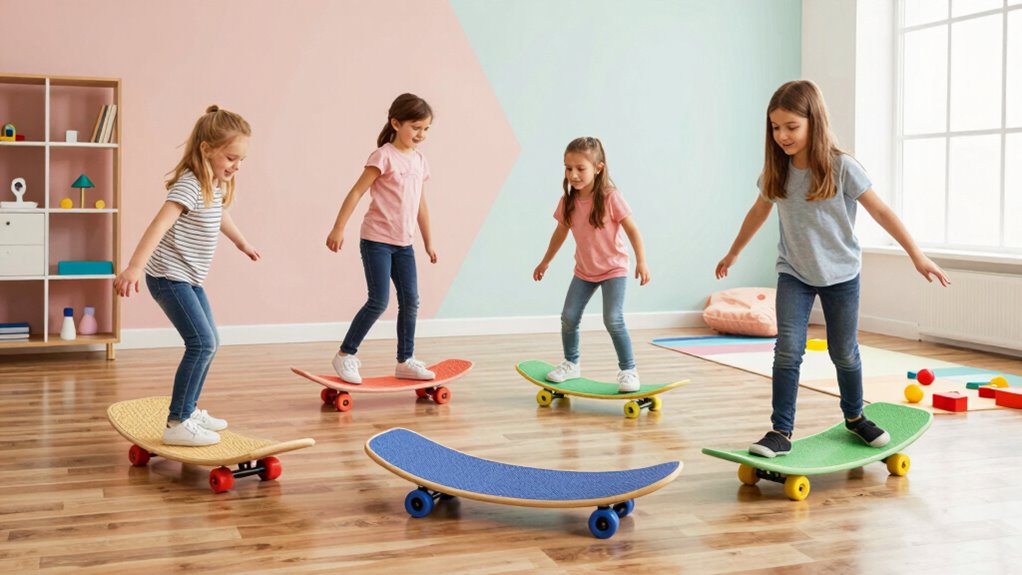

A wobble board for kids can turn balance practice into active indoor play, but the right choice depends on your child’s age, confidence, and available space. My best overall pick is the Simplay3 Two-Sided Rocking Wobble Disk and Climbing Dome for families who want more than one way to play. The Acorn Avenue felt rocker board is a better fit for quieter indoor use, while the Kids Maze Balance Board with Bag adds a guided challenge and easier storage. The main tradeoffs are between a simple, stable rocker and a more demanding wobble surface, as well as between compact plastic designs and larger wooden boards. Read on for the full comparison and advice on matching a board to your child and home.

Get health and wellness essentials delivered free with Prime
- Fast, free delivery on millions of items
- Prime Video, Amazon Music and more included
- Member-only deals all year
Key Takeaways
- The amazon.com/dp/B0BVGHH1XP?tag=healthdailyguide-20&ascsubtag=dc-671406″ target=”_blank” rel=”nofollow sponsored noopener”>Simplay3 stands apart from the flat balance boards by offering two-sided rocking and climbing play, making it the most versatile pick for families who want varied movement.
- Maze boards add a clear play goal that can help hold a child’s attention, but they may be less appealing to kids who prefer open-ended rocking.
- The Acorn Avenue’s felt-covered rocker design is aimed at indoor floors; families seeking a board for rougher play or outdoor use should check the listed surface and care guidance closely.
- The 35- and 36-inch wooden boards offer a larger rocking platform than compact maze and disk styles, but they need more room to store and use safely.
- Several models are described for both children and adults, yet age ranges and construction details vary; do not treat shared-use labeling as proof that every board suits every child.
| Simplay3 Two-Sided Rocking Wobble Disk and Climbing Dome for Toddlers and Kids |  | Best for Active Indoor-Outdoor Play | Brand: Simplay3 | Material: One-piece molded plastic | Color: Yellow/Green | VIEW ON AMAZON | See Our Full Breakdown |
| Juoe Balance Board Wobble Board for Physical Therapy and Fitness |  | Best for Shared Family Use | Dimensions: 17.5 × 13.5 × 3 inches | Material: Non-toxic hardwood plywood | Maximum load: 350 lbs | VIEW ON AMAZON | See Our Full Breakdown |
| Kids Maze Balance Board with Bag, 2-in-1 Sensory Training Toy, Ages 3-12 |  | Best for Progressive Maze Play | Brand: Oranmew | Age range: 3+ years | Dimensions: 18.2 × 11.5 × 3.2 inches | VIEW ON AMAZON | See Our Full Breakdown |
| Kids Maze Balance Board, 2-in-1 Wobble Sensory Training Toy |  | Best for Clearly Specified Capacity | Brand: LWuuywa | Age range: 3–12 years | Material: PP+PE plastic | VIEW ON AMAZON | See Our Full Breakdown |
| Acorn Avenue Non Slip Balance Board – Felt Rocker Board for Kids |  | Best for Open-Ended Rocker Play | Material: Wood | Bottom: Soft felt | Use: Indoor and outdoor | VIEW ON AMAZON | See Our Full Breakdown |
| Juoe 360° Maze Balance Board Wobble Board |  | Best for Game-Led Balance Practice | Dimensions: 17.5 × 12 × 3 inches | Material: Wood | Weight capacity: 350 lb | VIEW ON AMAZON | See Our Full Breakdown |
| 36″ Balance Board for Kids – Wooden Wobble Board, Montessori Balance Toy |  | Best for Imaginative, Open-Ended Play | Dimensions: 10.23 inches wide; 36.6-inch outer arc | Material: Natural beech wood | Weight capacity: 390 lb | VIEW ON AMAZON | See Our Full Breakdown |
| Amazon Basics Wood Wobble Balance Trainer Board – Slip-Resistant for Exercise and Core Strength |  | Best for Structured Balance Exercises | Dimensions: 15.75 × 15.75 × 3.15 inches | Material: Solid wood top | Weight capacity: 265 lb | VIEW ON AMAZON | See Our Full Breakdown |
| Gentle Monster Wooden Wobble Balance Board, 35 Inch Natural Wood Rocker Board for Kids & Adults |  | Best for High-Capacity Family Use | Length: 35 inches | Width: 11.8 inches | Thickness: 0.66 inches | VIEW ON AMAZON | See Our Full Breakdown |
| Nutty Toys Montessori Wooden Wobble Board for Kids & Adults |  | Best for Specified Child-Safe Finish | Size: 35 × 11.8 × 0.7 inches | Material: Natural wood | Weight capacity: 488 lb | VIEW ON AMAZON | See Our Full Breakdown |
| Kids Balance Board – Natural Wood Wobble Board with Non-Slip Safety Pads for Indoor/Outdoor Play, Suitable for Ages 3-12 |  | Best for Grip-Focused Play | Material: Natural wood | Listed dimensions: 27.5″ L x 9.25″ W x 6.2″ H | Alternate listed size: 30 x 10 inches | VIEW ON AMAZON | See Our Full Breakdown |
| 36″ Wooden Balance Board for Kids – Montessori Wobble Board & Rocker Toy |  | Best for Imaginative, Shared Play | Brand: Play22 | Material: Wood | Dimensions: 32.2″ L x 11.75″ W x 7.3″ H | VIEW ON AMAZON | See Our Full Breakdown |
| wobble board for kid | Material | Dimensions |
|---|---|---|
| Simplay3 Two-Sided Rocking Wob | One-piece molded plastic | — |
| Juoe Balance Board Wobble Boar | Non-toxic hardwood plywood | 17.5 × 13.5 × 3 inches |
| Kids Maze Balance Board with B | Polyethylene (PE) | 18.2 × 11.5 × 3.2 inches |
| Kids Maze Balance Board | PP+PE plastic | 18.2 × 11.5 × 3.2 inches |
| Acorn Avenue Non Slip Balance | Wood | — |
| Juoe 360° Maze Balance Board W | Wood | 17.5 × 12 × 3 inches |
| 36" Balance Board for Kids | Natural beech wood | 10.23 inches wide; 36.6-inch outer arc |
| Amazon Basics Wood Wobble Bala | Solid wood top | 15.75 × 15.75 × 3.15 inches |
| Gentle Monster Wooden Wobble B | Natural real wood | — |
| Nutty Toys Montessori Wooden W | Natural wood | — |
| Kids Balance Board | Natural wood | — |
| 36" Wooden Balance Board for K | Wood | 32.2" L x 11.75" W x 7.3" H |
More Details on Our Top Picks
Simplay3 Two-Sided Rocking Wobble Disk and Climbing Dome for Toddlers and Kids
I’d choose the Simplay3 Two-Sided Rocking Wobble Disk for families who want more than a balance exercise: flip it over and it becomes a climbing dome. Molded-in grip handles give younger children a place to steady themselves while rocking, while the climbing side adds a different kind of active challenge. Compared with the Acorn Avenue Felt Rocker Board, this model is better suited to outdoor play and climbing, but it offers less open-ended rocker-style use. Its one-piece weather-proof plastic and no-assembly design make setup simple, though plastic can show wear and the yellow-and-green color may not suit every room. I’d favor it for toddlers and kids who like changing activities over a traditional wooden board.
Pros:- Flips between a rocking wobble disk and a climbing dome for two distinct play modes.
- Molded-in grip handles give children support as they practice balance.
- Weather-proof construction suits indoor and outdoor use.
- Requires no assembly.
Cons:- Plastic may show wear with extended or rough use.
- Yellow-and-green is the only listed color.
- The climbing-dome format offers less of the open-ended rocker play found on the Acorn Avenue board.
Best for: Families seeking a ready-to-use balance and climbing toy for active toddlers and kids, indoors or outdoors.
Not ideal for: Buyers who want a wooden rocker for imaginative bridge or tunnel play, or who need a subdued color palette.
- Brand:Simplay3
- Material:One-piece molded plastic
- Color:Yellow/Green
- Use:Indoor and outdoor
- Assembly:Not required
- Play modes:Rocking wobble disk and climbing dome
- Origin:Made in USA
- Quantity:1 pack
Our verdict“Choose this if your child will get more use from a sturdy indoor-outdoor climber that also rocks than from a traditional wooden balance board.”
Juoe Balance Board Wobble Board for Physical Therapy and Fitness
The Juoe Balance Board stands out for households where children and adults want to use the same board. Its 350-pound maximum load and 17.5-by-13.5-inch footprint make it more like a shared exercise tool than a small, child-specific game. The non-slip silicone edge and textured surface support practice on different floors, while the hardwood plywood build contrasts with the plastic maze boards from Oranmew and LWuuywa, which add guided play and progressive maze challenges. Juoe’s simpler surface puts the focus on balance and body control rather than keeping a child engaged with a ball-and-maze task. That may suit family exercise or therapy routines, but the larger movement area takes room, and children already comfortable on balance boards may want a greater challenge.
Pros:- 350-pound maximum load supports use by children and adults.
- Non-slip silicone edge and textured surface help with grip on various floors.
- Hardwood plywood construction is non-toxic and odorless, according to the product description.
- Fully assembled for use without setup.
Cons:- Its exercise-focused design lacks the maze play offered by the Oranmew and LWuuywa boards.
- The 17.5-by-13.5-inch footprint requires dedicated floor space.
- May feel too easy for users already experienced with balance training.
Best for: Families who want one hardwood balance board for a child’s practice and adult fitness or therapy exercises.
Not ideal for: Buyers whose child needs a maze-based play activity, or who have limited floor space for balance exercises.
- Dimensions:17.5 × 13.5 × 3 inches
- Material:Non-toxic hardwood plywood
- Maximum load:350 lbs
- Assembly:Fully assembled
- Grip features:Non-slip silicone edge and textured surface
- Intended users:Children and adults
Our verdict“Pick Juoe if you want a straightforward hardwood board that can serve both kids’ balance practice and adult exercise.”
Kids Maze Balance Board with Bag, 2-in-1 Sensory Training Toy, Ages 3-12
I’d shortlist the Oranmew Kids Maze Balance Board for children who stay engaged when a physical task also gives them a clear play goal. Its interchangeable maze plates and balls provide nine challenge levels, giving kids a reason to keep practicing as steering the ball becomes more demanding. That guided activity sets it apart from the Juoe Balance Board, which is geared toward straightforward balance and exercise rather than maze play. The quiet, floor-friendly base is a plus for indoor use, while the 18.2-by-11.5-inch board needs more space than a compact toy. The listing identifies PE construction and includes a bag, but it does not provide a maximum load or describe the specific age range beyond 3+; buyers wanting those details should compare it with the LWuuywa maze board, which lists a 140-pound capacity.
Pros:- Three interchangeable maze boards and three balls create nine challenge combinations.
- Combines balance practice with a goal-directed ball maze.
- Quiet rubber base is designed to reduce noise and protect floors.
- Includes a bag for storing the board and accessories.
Cons:- The 18.2-by-11.5-inch board may not fit very small play spaces.
- No maximum weight capacity is provided in the product details.
- The listing does not specify a full age range beyond 3+.
Best for: Caregivers of children aged 3 and up who want an indoor balance activity with multiple maze challenges and included storage.
Not ideal for: Buyers who need a stated maximum load, a compact board for a very small play area, or a plain balance trainer without maze pieces.
- Brand:Oranmew
- Age range:3+ years
- Dimensions:18.2 × 11.5 × 3.2 inches
- Material:Polyethylene (PE)
- Challenge levels:9
- Maze boards:3 interchangeable boards
- Balls:3
- Number of items:7
- Included storage:Bag
Our verdict“Choose Oranmew for a child who is more likely to practice balance when each wobble also moves a ball through a changing maze.”
Kids Maze Balance Board, 2-in-1 Wobble Sensory Training Toy
The LWuuywa Kids Maze Balance Board is the more specification-forward choice for shoppers comparing maze-style wobble toys: the listing gives an age range of 3–12 and a 140-pound weight capacity. It pairs balance play with interchangeable labyrinth boards and three different ball materials, so children can work on steering while moving on the board. Like the Oranmew Kids Maze Balance Board, it offers a quiet rubber base and a similar footprint; LWuuywa distinguishes itself with its stated capacity and CPSC certification. In exchange, its PP+PE plastic may feel less substantial than a wood board, and the gray color is the only one listed. I’d choose it over Juoe for sensory-style play, but choose Juoe when adult sharing and a higher listed load are priorities.
Pros:- Lists a 140-pound maximum weight capacity and CPSC certification.
- Includes three labyrinth boards and balls made from wood, plastic, and rubber.
- Non-slip pedals and quiet rubber base support indoor floor use.
- Rounded edges are specified in the product description.
Cons:- The 140-pound limit makes it less suited to shared adult use than the Juoe board.
- Plastic construction may feel less substantial than hardwood alternatives.
- Only gray is listed as a color option.
Best for: Caregivers seeking a maze-based indoor wobble toy for ages 3–12 who want a stated weight limit and listed safety certification.
Not ideal for: Families who need a board for adult use, prefer wood construction, or want more color choices.
- Brand:LWuuywa
- Age range:3–12 years
- Material:PP+PE plastic
- Dimensions:18.2 × 11.5 × 3.2 inches
- Item weight:2.9 lbs
- Maximum weight capacity:140 lbs
- Included accessories:3 balls and 3 replacement labyrinth boards
- Certification:CPSC certified
- Color:Gray
Our verdict“Choose LWuuywa if you want a maze-focused board with a stated child age range, capacity, and certification rather than an adult-shareable trainer.”
Acorn Avenue Non Slip Balance Board – Felt Rocker Board for Kids
The Acorn Avenue Felt Rocker Board makes sense for families who want a simple wooden curve that can shift between wobbling, rocking, and imaginative play as a bridge or tunnel. Its soft felt bottom is the defining practical difference: compared with the plastic Simplay3 disk, it is better aimed at indoor floors where surface protection matters, though Simplay3 is the clearer choice for outdoor use and climbing. Acorn Avenue also leaves more room for child-led play than the LWuuywa maze board, which directs attention toward moving balls through a labyrinth. The tradeoff is sparse product information: no age range, dimensions, or weight capacity are supplied here, and the wooden board may be heavy for a young child to move. I’d pick it for imaginative indoor play, not when fit and capacity details drive the decision.
Pros:- Supports several play styles, including rocking, wobbling, bridge play, and tunnel play.
- Wood construction offers a different feel from the plastic maze boards.
- Soft felt bottom is designed to protect floors.
- Listed for indoor and outdoor use.
Cons:- No age range or maximum weight capacity is provided.
- The board may be heavy for young children to move independently.
- Product details do not include dimensions, making fit harder to judge.
Best for: Families who want a wooden rocker for open-ended indoor play, floor-conscious use, and activities such as bridging or tunneling.
Not ideal for: Buyers who need a stated age range, dimensions, weight capacity, or a lightweight board a young child can easily move.
- Material:Wood
- Bottom:Soft felt
- Use:Indoor and outdoor
- Play styles:Wobbling, rocking, bridge, and tunnel play
Our verdict“Choose Acorn Avenue for open-ended wooden rocker play and a felt floor contact surface, provided the missing size and capacity details are not deal-breakers.”
Juoe 360° Maze Balance Board Wobble Board
The integrated maze gives this compact board a clear advantage for children who need an activity to hold their attention while they practice balancing. At 17.5 by 12 inches, it takes up less room than the 35-inch rocker boards from Gentle Monster and Nutty Toys, though it offers less space for imaginative uses such as a lounge or bridge. The one-piece wooden design arrives fully assembled, and its anti-slip surface and floor-protection pads suit indoor play. Its 350-pound capacity also allows adult participation, but the narrow, game-focused format is less suited to shared rocking or broad movement play. Choose it for short, engaging balance sessions rather than as a large, open-ended play board.
Pros:- Integrated maze adds a focused play activity to balance practice.
- Compact footprint fits more easily into smaller indoor play areas than 35-inch rocker boards.
- Arrives fully assembled for immediate use.
- Anti-slip surface and protective pads address grip and floor protection.
Cons:- Its smaller size offers less room for broad rocking and imaginative uses than long rocker boards.
- The provided product information includes no durability data beyond the stated construction.
Best for: Families looking for a space-conscious board that pairs balance practice with a built-in maze game.
Not ideal for: Buyers who want a long rocker for imaginative play, shared use, or full-body yoga-style movement.
- Dimensions:17.5 × 12 × 3 inches
- Material:Wood
- Weight capacity:350 lb
- Assembly:Fully assembled
- Surface:Anti-slip
- Additional features:Integrated maze and protective pads
Our verdict“Choose the Juoe maze board for compact, game-based balance play, but pick a full-length rocker for more open-ended movement.”
36″ Balance Board for Kids – Wooden Wobble Board, Montessori Balance Toy
This 36.6-inch beechwood rocker is the most play-flexible choice here: children can turn it into a swing, slide, stage, boat, or lounge spot, rather than using it only as a balance trainer. That versatility separates it from the Juoe 360° Maze board, which offers a more focused game in a much smaller footprint. Its 390-pound capacity and rounded edges support family use, while the natural wood keeps play free of batteries and screens. The tradeoff is space: at more than three feet long, it is harder to store or leave out in a small room. I’d favor this model for children who invent new uses for their toys; families seeking a dedicated fitness surface may prefer the square Amazon Basics trainer.
Pros:- Long rocker supports several imaginative play uses beyond balance training.
- Natural beech wood construction and rounded edges suit indoor family play.
- 390-pound capacity accommodates more than one age group.
- No batteries or electronic components are needed.
Cons:- Large footprint can be difficult to fit or store in a small room.
- Its open-ended rocker shape is less purpose-built for stationary fitness exercises than the Amazon Basics trainer.
Best for: Families with room for a full-length rocker and children who enjoy inventing varied indoor play scenarios.
Not ideal for: Apartment dwellers or buyers who need a compact board that stores easily or focuses on structured exercise.
- Dimensions:10.23 inches wide; 36.6-inch outer arc
- Material:Natural beech wood
- Weight capacity:390 lb
- Warranty:12 months
- Design:Open-ended rocker
- Edge detail:Rounded edges
Our verdict“Pick this board when imaginative play and a long rocker matter more than compact storage or exercise-focused design.”
Amazon Basics Wood Wobble Balance Trainer Board – Slip-Resistant for Exercise and Core Strength
Unlike the long rocker boards from Gentle Monster and Nutty Toys, this square trainer is built around standing balance work and exercises such as planks and push-ups. Its 15.75-inch solid-wood top gives a defined platform for those movements, while the non-slip surface helps maintain foot or hand contact during a session. That makes it a better fit for a supervised exercise routine than a child-led pretend-play toy. The 265-pound capacity is lower than the listed limits on the other boards in this group, and the use instructions call for a dry, non-slippery surface. Families should be cautious about using it on smooth flooring, even though the board itself has a grippy top. Its one-year limited warranty is specified.
Pros:- Square platform suits standing poses, planks, and push-ups.
- Solid-wood top provides a defined base for structured exercise.
- Non-slip surface supports contact during use.
- One-year limited warranty is specified.
Cons:- 265-pound capacity is lower than the stated limits of the other boards in this group.
- Must be used on a dry, non-slippery surface, limiting where it can be used safely.
- Less suited to imaginative rocking play than the long wooden boards.
Best for: Families seeking a compact, exercise-oriented board for supervised balance drills, planks, or push-ups.
Not ideal for: Buyers who want a long imaginative-play rocker, or whose available floor surface is smooth, wet, or slippery.
- Dimensions:15.75 × 15.75 × 3.15 inches
- Material:Solid wood top
- Weight capacity:265 lb
- Surface:Non-slip
- Warranty:1-year limited
- Use guidance:Use only on dry, non-slippery surfaces
Our verdict“Choose the Amazon Basics board for supervised, exercise-led balance work on a suitable floor rather than open-ended kids’ play.”
Gentle Monster Wooden Wobble Balance Board, 35 Inch Natural Wood Rocker Board for Kids & Adults
For families who expect children and adults to share one rocker, the 480-pound capacity makes this 35-inch board a stronger fit than the Juoe maze board or Amazon Basics trainer. Its natural wood rocker shape supports imaginative play as well as balance practice and yoga, so it can serve several ages and activities without built-in games or electronics. The 11.8-inch width keeps the profile relatively narrow, but the 35-inch length still requires storage space. Compared with the similar-sized Nutty Toys board, Gentle Monster lists a three-year protection period and a slightly lower capacity; Nutty Toys states 488 pounds and a non-toxic coating. The product details do not specify a non-slip surface, so buyers should account for the floor and supervision when choosing where children use it.
Pros:- 480-pound stated capacity supports use by children and adults.
- 35-inch rocker works for balance practice, yoga, and imaginative play.
- Natural wood construction has individual grain patterns.
- Three-year protection period is specified.
Cons:- Long rocker requires more storage space than compact boards such as the Juoe maze model.
- Product details do not specify a non-slip surface.
- Nutty Toys lists a slightly higher capacity and a non-toxic coating.
Best for: Households wanting one long natural-wood rocker for children and adults, with a stated capacity suited to shared family use.
Not ideal for: Families short on storage space or buyers who require a stated non-slip surface or a non-toxic coating specification.
- Length:35 inches
- Width:11.8 inches
- Thickness:0.66 inches
- Height:6 inches
- Material:Natural real wood
- Weight capacity:480 lb
- Protection period:3 years
Our verdict“Choose Gentle Monster for a shared, long-form family rocker with a specified protection period, provided its size and surface details suit your home.”
Nutty Toys Montessori Wooden Wobble Board for Kids & Adults
Nutty Toys combines a familiar 35-inch open-ended rocker with two useful specifications for families: a stated non-toxic coating and an age range starting at three years. Those details give it a clearer finish and age brief than the Gentle Monster board, which shares its 35-inch length but lists a three-year protection period and a 480-pound capacity. Nutty Toys states 488 pounds, though neither capacity figure should replace adult supervision during children’s play. The long, natural-wood shape invites imaginative use as well as balance practice, but it also takes up room and is described as heavy, making it less convenient to move or put away than the compact Juoe maze board. This is the more specification-led pick for families prioritizing the finish and stated age range.
Pros:- Non-toxic coating is specified in the product details.
- Age range begins at three years.
- Open-ended rocker supports balance, coordination, strength, and imaginative play.
- 488-pound stated capacity is the highest among the five products in this batch.
Cons:- 35-inch length and stated heavy weight make storage and frequent moving less convenient.
- Younger children require supervision during use.
- Unlike the Juoe maze board, it has no built-in game to structure play.
Best for: Families seeking a full-length wooden rocker with a stated non-toxic coating and an age range beginning at three years.
Not ideal for: Buyers with limited storage, those who need a lightweight board to move frequently, or anyone seeking a compact maze-style activity.
- Size:35 × 11.8 × 0.7 inches
- Material:Natural wood
- Weight capacity:488 lb
- Age range:3 years and up
- Coating:Non-toxic
- Design:Open-ended rocker
Our verdict“Pick Nutty Toys if a specified non-toxic finish and a long, versatile rocker matter more than easy storage or built-in activities.”
Kids Balance Board – Natural Wood Wobble Board with Non-Slip Safety Pads for Indoor/Outdoor Play, Suitable for Ages 3-12
This board suits families who want a straightforward rocker with non-slip safety pads and a natural-wood build. Its 27.5-inch listed length and gentle curve give kids a familiar back-and-forth balance challenge, while rounded edges support everyday play. Compared with the larger Play22 36-inch board, this one takes up less room and has a lower stated weight limit, making it a more child-focused choice rather than a shared family board. The tradeoff is that the product data lists two different size descriptions, and the smaller listed dimensions may feel restrictive as a child grows. Its black color is also less visually adaptable than the Play22’s natural wood finish. I’d choose it for basic rocking practice, not for a large play surface or adult use.
Pros:- Non-slip safety pads are included for added grip during play.
- Natural wood construction offers a simple, durable play surface.
- Gentle curve supports basic balance and coordination practice.
- Listed as suitable for indoor and outdoor use.
Cons:- Product data gives conflicting size descriptions: 27.5 x 9.25 inches and 30 x 10 inches.
- The 158-pound maximum recommendation is lower than the Play22 board’s stated 330-pound limit.
- Black is the only color mentioned, with no finish options listed.
Best for: Families seeking a child-focused wooden rocker with included grip pads for indoor or outdoor play.
Not ideal for: Households wanting a roomy board for older children or adults, or buyers who need consistent sizing details before ordering.
- Material:Natural wood
- Listed dimensions:27.5″ L x 9.25″ W x 6.2″ H
- Alternate listed size:30 x 10 inches
- Maximum weight recommendation:158 lbs
- Color:Black
- Safety features:Non-slip pads and rounded edges
- Suggested age range:Ages 3–12
- Play setting:Indoor and outdoor
Our verdict“Choose this board for a compact, grip-equipped rocker for children, but pick the larger Play22 if you want more room to grow or share.”
36″ Wooden Balance Board for Kids – Montessori Wobble Board & Rocker Toy
The Play22 stands out for families who want a wobble board that can become more than a rocker. Its 32.2-inch length and 11.75-inch width give children room to balance, while the board’s listed uses—including a bridge, tunnel, ramp, boat, and seat—encourage play beyond rocking. Compared with the more compact Kids Balance Board with Non-Slip Safety Pads, Play22 offers a larger surface and a much higher stated weight recommendation, so it has more potential for shared use as children grow. That extra scale has a downside: it needs more storage space, and its 4.5-pound weight may make it less convenient for young children to reposition. I’d choose it when open-ended play matters more than a small footprint or a dedicated grip-pad feature.
Pros:- Large 32.2 x 11.75-inch surface offers more room than the smaller kids’ board in this roundup.
- Open-ended shape supports multiple play configurations, from rocker to bridge or tunnel.
- Stated 330-pound maximum weight recommendation allows broader shared use.
- Natural wood construction and smooth edges suit play for ages 3 and up.
Cons:- Its larger footprint can be awkward to store in a small living space.
- At 4.5 pounds, it may be harder for younger children to move independently.
- The description lists many play uses but does not mention non-slip pads.
Best for: Families with space for a larger board who want one wooden toy for balance practice and imaginative play.
Not ideal for: Small-home households or families looking for a compact rocker with included non-slip safety pads.
- Brand:Play22
- Material:Wood
- Dimensions:32.2″ L x 11.75″ W x 7.3″ H
- Item weight:4.5 pounds
- Maximum weight recommendation:330 pounds
- Color:Natural wood
- Age range:Ages 3+
- Listed play configurations:Rocker, bridge, tunnel, ramp, racetrack, boat, slide, and seat
Our verdict“Pick Play22 if you have storage room and want a larger, multi-use board; choose the smaller padded board for a more compact, grip-focused rocker.”

How We Picked
I compared the 12 listed boards by the factors that shape day-to-day use: play style, age fit, surface grip, construction, footprint, and versatility. A board earns a higher place when its format gives families a clear benefit beyond basic rocking, such as multiple play modes, a guided balance activity, or a design suited to quieter indoor use. I also weighed whether the product description gives buyers useful information about who the board is for and where it may work best.
The ranking reflects those distinctions rather than treating every wobble board as interchangeable. The Simplay3 leads for its two-sided play options; the Acorn Avenue and maze-board options stand out for more specific needs. Larger wooden rockers may suit open-ended movement and shared use, but their size and the need to confirm grip and room fit make them less universal. Where the supplied product details do not establish a feature or safety limit, I avoid assuming it.
Factors to Consider When Choosing Wobble Board For Kids
Before choosing a style, think about how your child will actually use a board and where it will live. Age, confidence, floor surface, and available space can matter more than a long feature list. These broader checks can help prevent a board from being too challenging, too bulky, or poorly suited to your home.
Match the Movement Challenge to Your Child
A board that feels exciting to one child may feel unstable or frustrating to another. For a beginner, a broad, controlled rocking motion may be easier to approach than a design that asks the child to steer a ball through a maze. Consider whether your child already enjoys standing balance games, or whether they are more comfortable sitting, kneeling, or using a board with an adult nearby. Choose a challenge they can repeat without turning every attempt into a test. A stated age range is a useful starting point, not a substitute for judging coordination, confidence, and supervision needs.
Check Grip Against Your Floors
Grip matters both where a child stands and where the board meets the floor. A non-slip standing surface can help feet stay in place, but it does not automatically mean the underside will stay put on every floor. Felt may help protect some indoor surfaces, while a board intended for different settings may use another approach; verify the manufacturer’s instructions rather than guessing. Avoid placing any board on loose rugs, uneven ground, or a slick surface unless the product guidance supports that use. A common mistake is choosing based on the top surface alone and overlooking how the board behaves on the family’s actual flooring.
Measure the Play and Storage Area
A larger board can give a child more room to shift their stance, but it also takes up more space while in use and between play sessions. Measure a clear area that allows the board to rock without striking furniture, walls, or other children. Remember that a child’s arms and feet extend beyond the board during movement, so the board’s dimensions alone do not define the needed space. Compact maze or disk styles can be easier to put away, while a long wooden rocker may be more appealing for open-ended play. If storage is tight, portability and a supplied bag may influence the choice as much as the play surface.
Decide Whether One Play Style Will Last
Some children like a focused task, such as guiding a ball through a maze, while others prefer making up their own rocking games. A maze can give play a clear goal, but a child who wants to rock, sit, or use the board in imaginative play may prefer a simpler shape. Two-sided designs can offer a change of activity without adding a separate toy, though added versatility is only useful if the family has room and the child enjoys both sides. Think about whether the board is meant for short balance sessions, everyday active play, or several types of use. Buying the most feature-rich style is not a win if its main activity does not suit the child.
Treat Shared Use as a Fit Question
Boards marketed for children and adults may appeal to households looking for a shared item, but labels alone do not show how comfortable or suitable a particular board will be for each person. Check the product’s stated limits and instructions before an adult uses it, and do not infer a weight capacity from the board’s dimensions or material. A child-sized maze board and a long wooden rocker can feel very different to an adult, even when both are described as suitable for multiple ages. If several family members will use the same board, compare their needs and select a design whose intended use clearly covers them. When that information is missing, contact the seller or choose a product with clearer specifications.
Know When Added Features Are Worth It
Extra activities, a carry bag, or a finish intended for indoor floors can solve a real household need, but each feature should have a purpose. A bag may help keep a portable board together, while a two-sided design can add variety for a child who quickly tires of a single movement. Neither feature replaces checking board size, grip, age guidance, or use instructions. Pay more attention to build and documented suitability when the board will be used often or shared across ages; avoid paying for add-ons your child is unlikely to use. Clear specifications are more useful than broad claims, especially when choosing for active or unsupervised play.
Frequently Asked Questions
Which type of wobble board is easiest for a young beginner to try?
Look for a design that offers a simple, predictable rocking motion and a usable standing area, rather than choosing by age range alone. A maze board adds a coordination task, which may suit a child who enjoys guided games but can distract or frustrate a beginner who is still getting comfortable with balance. Start with close adult supervision and follow the maker’s instructions for use. Keep the play area clear and let the child decide whether to stand, sit, or stop. A child’s confidence and coordination are better guides than assuming every board marked for young ages will feel easy.
Is a maze board a good choice if my child already likes balance toys?
It can be a good next step if your child enjoys having a goal while moving, since guiding a ball through a maze adds a coordination element to balancing. It is not automatically a better choice than a plain rocker: children who prefer free movement may find the task restrictive. Consider whether the maze activity is central to how your child plays or just an occasional novelty. A simpler board may allow more open-ended games, while a maze format gives each turn a defined challenge. If you are unsure, prioritize the play style your child returns to most often.
Can I use a kids’ wobble board on hardwood floors?
That depends on the board’s underside and the manufacturer’s directions, not just on whether its top has a non-slip texture. Felt-covered models are specifically positioned for indoor floor use, but you should still check care instructions and confirm that the board is stable on your surface. Keep the area free of rugs and objects that could shift or catch the board. If the product does not clearly describe suitable flooring, do not assume it is safe for hardwood. A short, supervised trial on a clear floor can help reveal whether the board shifts, while following the maker’s guidance.
Should I choose a wooden board or a plastic wobble board?
Material alone does not tell you which board is the better fit. A wooden rocker may offer a larger, open-ended play surface, while a plastic model such as the Simplay3 can stand out for alternate play modes. Compare dimensions, intended use, surface grip, and care instructions before deciding. A large board may be less convenient in a small room, and a compact design may not offer the same range of movement. Choose based on where the board will be used and how your child likes to play, rather than treating either material as automatically more durable or safer.
What should I check before buying a board that adults may also use?
Look for explicit manufacturer guidance on intended users, weight limits, and use conditions; do not infer adult suitability from a product title or a broad age label. Check the board’s dimensions and whether its shape makes sense for the adults who may use it. Also review surface grip and instructions for the floor where it will be used. If key limits are not listed, ask the seller before purchasing or using the board. Shared use can make a single board more useful, but only when its stated specifications cover every intended user.
Conclusion
For most households, I’d start with the Simplay3 as the best overall because its two-sided design offers more than one kind of play. The Kids Maze Balance Board with Bag is my best value-style pick for guided play and easier storage, while the Acorn Avenue is the better fit for families who want a felt rocker for indoor use. For beginners, choose the simplest rocking format that suits your child’s confidence and floor space rather than jumping straight to a maze challenge. If you want a larger, open-ended wooden rocker or a board marketed for shared family use, compare the 35- and 36-inch options and verify dimensions, grip, and user limits before buying. The best choice is the one your child can use comfortably in the space you have, with its intended use clearly matched to your needs.
Cold & flu season Picks
humidifiers
As an affiliate, we earn on qualifying purchases.