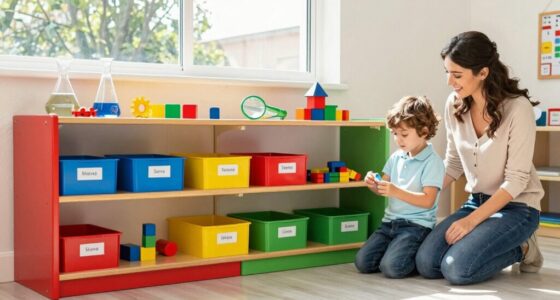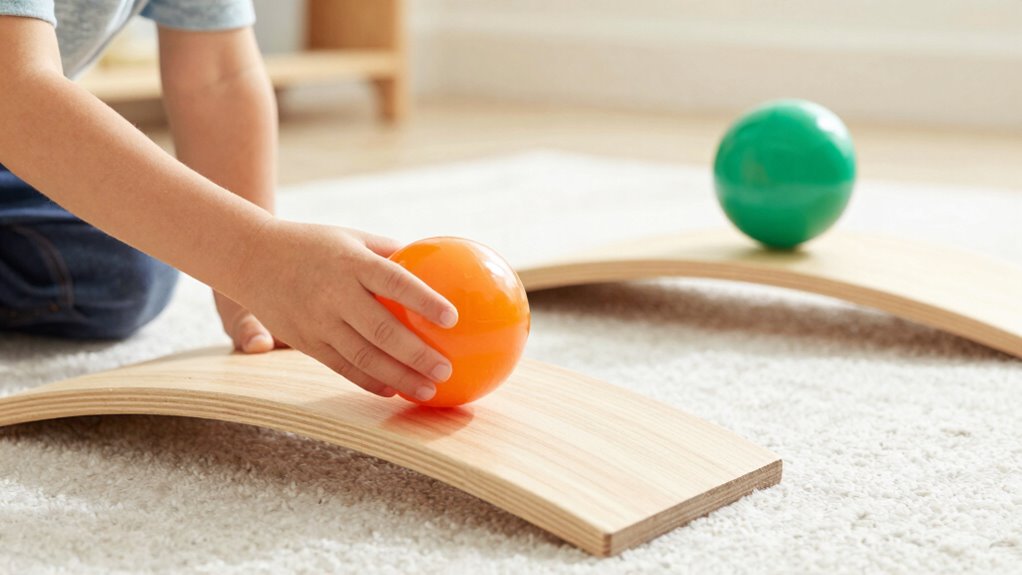

To use ramps and balls for early physics play, set up ramps at different angles and encourage children to roll various balls to observe how shape, weight, and surface affect motion. Let kids explore how smoother or rougher surfaces change speed, and try different ramp shapes to see how distance influences energy. Ask questions about their observations to build curiosity and understanding. Keep experimenting fun and simple, and you’ll find plenty more ways to make physics engaging.

Get health and wellness essentials delivered free with Prime
- Fast, free delivery on millions of items
- Prime Video, Amazon Music and more included
- Member-only deals all year
Key Takeaways
- Use different ramp angles to demonstrate how slope affects the speed and acceleration of rolling balls.
- Introduce various materials for ramps to explore how surface texture influences friction and motion.
- Incorporate different types of balls to show effects of weight and material on rolling behavior.
- Ask simple questions about changes in ramp shape, angle, or material to promote observation and critical thinking.
- Encourage hands-on experimentation to help children connect physical concepts like gravity with their play activities.
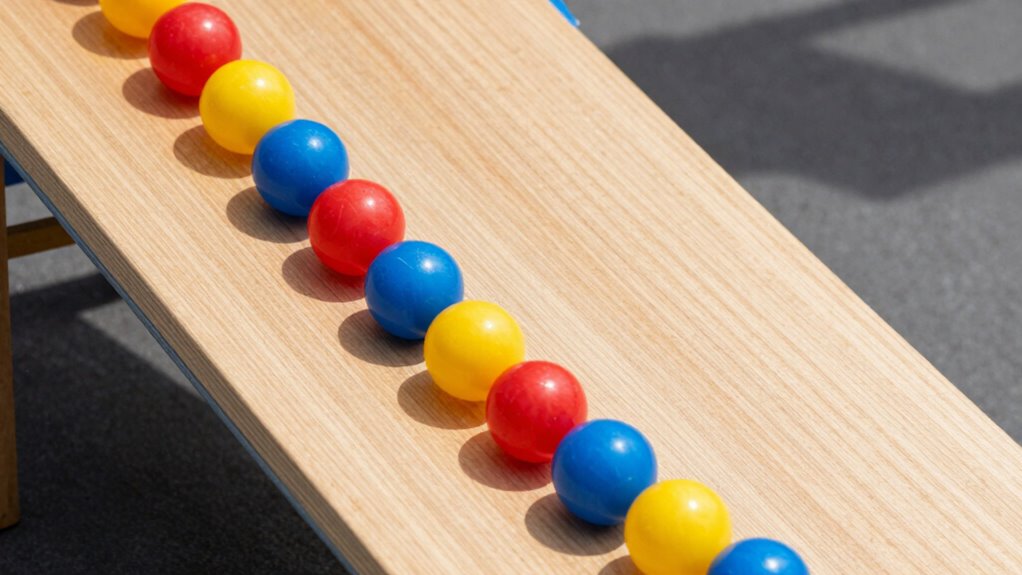
Playing with ramps and balls is a simple yet powerful way to introduce young children to the basic principles of physics. When you set up a ramp and roll a ball down it, you’re providing a hands-on experience that makes abstract concepts like gravity tangible. Kids naturally love the game of watching a ball accelerate as it moves downhill, and this curiosity creates an ideal opportunity for you to explain how gravity pulls objects toward the Earth. You can encourage children to observe how different angles of the ramp affect the speed of the ball, helping them understand that the steeper the incline, the faster the ball accelerates due to gravity’s influence.
Playing with ramps and balls helps kids understand gravity and how angles affect speed through fun, hands-on exploration.
As you guide children through these experiments, focus on exploring material properties. Different materials for ramps—such as wood, plastic, or metal—have unique textures, weights, and surface qualities that influence how smoothly a ball rolls. For example, a smooth, polished surface allows the ball to glide effortlessly, emphasizing the importance of low friction, while a rough or textured surface might slow the ball down, highlighting how surface friction impacts motion. By comparing how various materials affect the ball’s movement, children start to grasp that material properties play an essential role in how objects behave in the physical world. This comparison helps bridge the gap between simple play and scientific understanding.
You can make the activity more engaging by encouraging kids to experiment with different balls—perhaps a heavier rubber ball versus a lightweight plastic one—and observe how their material properties influence the outcome. Heavier balls might roll faster or farther depending on the surface, illustrating concepts like inertia and momentum. Additionally, experimenting with different ramp shapes and lengths can demonstrate how the path and distance impact the speed and energy of the rolling ball. These activities turn play into a science lesson, fostering curiosity and critical thinking.
Throughout the play, ask questions to prompt thinking: “How does changing the angle affect the speed?” or “What happens if we switch to a different material for the ramp?” By doing so, you help children connect their observations to scientific principles. The key is to keep the activities simple but rich with opportunities for discovery. Ramps and balls are versatile tools that make physics accessible and fun, laying a foundation for a lifelong interest in science while reinforcing vital concepts like gravity and material properties.
kids ramp and ball physics science kit
As an affiliate, we earn on qualifying purchases.
As an affiliate, we earn on qualifying purchases.
Frequently Asked Questions
What Age Is Suitable for Ramp and Ball Physics Activities?
You can start ramp and ball physics activities with children around age 3, but always supervise closely. At this age, their motor control is developing, so activities help improve coordination. Incorporate sensor calibration to guarantee safe, responsive play, and gradually introduce more complex concepts as their skills grow. This hands-on approach nurtures curiosity and foundational understanding of physics principles while supporting motor development and control.
How Can I Modify Ramps for Different Skill Levels?
Think of your ramps as a playground for growth, ready to adapt as skills blossom. You can modify ramps for different skill levels by introducing an adjustable incline, allowing the slope to become steeper or gentler. A modular design acts like building blocks, letting you add or remove sections to increase complexity or simplify. This flexibility keeps the challenge just right, nurturing confidence and discovery at every stage.
Are There Safety Concerns With Small Balls and Ramps?
Yes, there are safety concerns with small balls and ramps. You should prioritize ball safety by choosing age-appropriate, non-toxic balls that won’t pose choking hazards. Always supervise ramp play closely to prevent balls from falling or being misused. Keep the play area clear of obstacles, and regularly check the ramps for stability to avoid accidents. With proper supervision and safe equipment, your child can enjoy physics play safely.
What Materials Are Best for Building Durable Ramps?
Durable materials are key for building ramps that last through energetic play. Opt for sturdy options like hardwood, thick plastic, or metal, which offer excellent material durability. These choices also allow for ramp customization, giving you flexibility in design to suit your child’s curiosity. Avoid flimsy or brittle materials that may crack or break, ensuring a safer, more engaging experience. With the right materials, your ramps will stand the test of time and exploration.
How Do I Encourage Creative Problem-Solving During Play?
Encourage creative problem-solving by fostering an environment of creative exploration and DIY construction. Challenge yourself and your child to design new ramps and obstacles, experimenting with different angles and materials. Ask open-ended questions to spark ideas, like “What if we try this?” or “How can we make it faster?” Emphasize that making mistakes is part of learning, and celebrate inventive solutions to inspire ongoing curiosity and innovation.
early childhood physics experiment toys
As an affiliate, we earn on qualifying purchases.
As an affiliate, we earn on qualifying purchases.
Conclusion
By exploring ramps and balls, you ignite curiosity, foster discovery, and nurture understanding. You encourage exploration, inspire experimentation, and promote learning. With every roll, every tilt, and every drop, you build confidence, spark creativity, and develop critical thinking. Embrace these simple tools to turn play into a powerful learning experience, shaping minds that are curious, resilient, and enthusiastic to learn. In this journey, you’re not just playing—you’re laying the foundation for lifelong learning.
kids ramp and ball set for STEM learning
As an affiliate, we earn on qualifying purchases.
As an affiliate, we earn on qualifying purchases.
children's physics play set with ramps and balls
As an affiliate, we earn on qualifying purchases.
As an affiliate, we earn on qualifying purchases.
Fall Picks
fall essentials
As an affiliate, we earn on qualifying purchases.