TL;DR

Get health and wellness essentials delivered free with Prime
- Fast, free delivery on millions of items
- Prime Video, Amazon Music and more included
- Member-only deals all year
Fit&Well reports that personal trainer Chris Browning recommends shoulder presses, squats, planks, rows and glute bridges for beginners building strength at home. The routine uses two to three sets per exercise, with light dumbbells for the weighted moves; Browning advises increasing weight when the exercises become easy after several weeks of practice.
Personal trainer Chris Browning recommends five exercises—shoulder presses, bodyweight squats, planks, dumbbell rows and glute bridges—for people starting a home strength routine, according to Fit&Well. The selection is intended to be relatively simple to learn while working muscles across the body; the weighted exercises use a pair of fairly light dumbbells.
Fit&Well says Browning, who has more than 20 years of experience creating home workouts for clients, selected the movements for their accessibility and potential for progression. His suggested plan is two to three sets of each exercise. For presses, squats, rows and bridges, the recommendation is 10 to 15 repetitions; for planks, it is a 30- to 60-second hold.
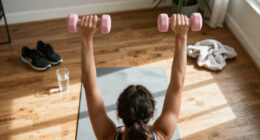
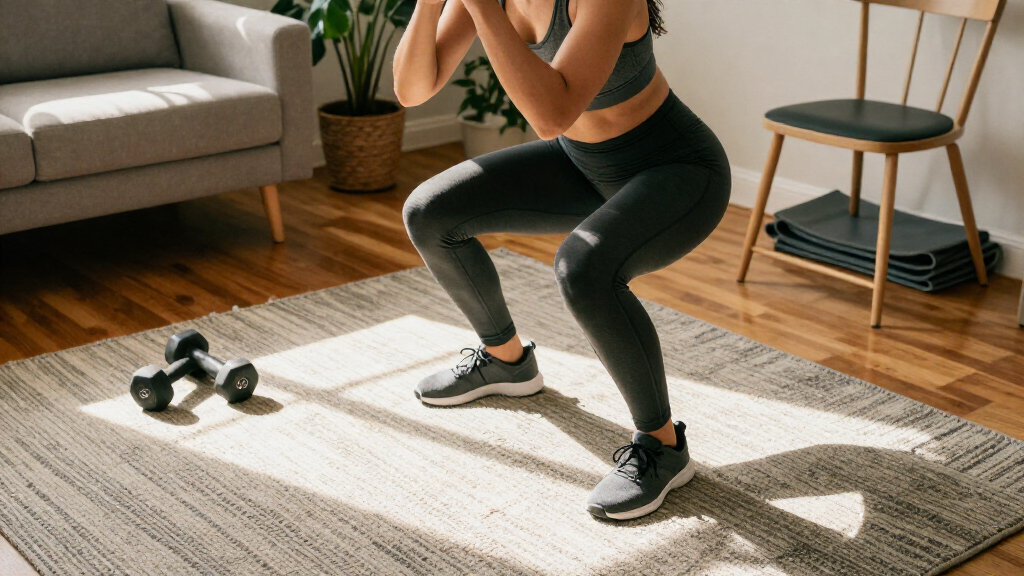
The seated dumbbell shoulder press is performed with a weight in each hand, pressing from shoulder height until the arms are nearly straight while keeping the torso upright. In the bodyweight squat, the exerciser bends the hips and knees, lowering only as far as comfortable, then pushes through the feet to stand. Keeping the knees aligned with the toes is one of the form cues in Fit&Well’s instructions.
For the plank, the routine calls for a straight body position with forearms on the floor and elbows beneath the shoulders. The row is done from hands and knees, pulling one dumbbell toward the hip before lowering it and repeating on the other side. The glute bridge is performed lying on the back, lifting the hips until the body forms a line from chest to knees and squeezing the glutes at the top.
A Five-Move Starting Routine
The routine gives new exercisers a defined set of movements rather than requiring gym machines or a complicated program. It includes upper-body pushing and pulling, lower-body movement, trunk bracing and hip extension, making it a practical introduction to several basic strength-training patterns.
Its suggested equipment is limited to one pair of light dumbbells for the shoulder press and row; the other movements use body weight. That makes the plan suitable for a home setting, though the source does not establish that this is the best routine for every beginner or that it will produce a particular fitness outcome.
Products Worth Considering

BowFlex Results Series SelectTech 552 Adjustable Dumbbell

BowFlex Results Series SelectTech Adjustable Dumbbells (Pair)

Levoit Eleva 300X HEPA Air Purifier for Home and Bedroom
As an affiliate, we earn on qualifying purchases.
How the Exercises Progress
Browning’s advice, as reported by Fit&Well, is to begin with weights that challenge the muscles safely and to increase the load only after the movements start to feel easy. The article suggests this may happen after practicing for a few weeks, but does not set a fixed timetable or specify how large a weight increase should be.
For the plank, Browning advises beginners to hold the position until it becomes challenging or uncomfortable, or until they can no longer keep proper form. That guidance puts maintaining technique ahead of extending the hold at any cost. Fit&Well’s listed set and repetition ranges are recommendations, not individualized training prescriptions.
Limits of the Published Guidance
Fit&Well’s report does not specify how often per week readers should perform the routine, how much rest to take between sets, or how to adapt each exercise for injuries, mobility limits or other individual needs. It also provides no study data comparing these five exercises with alternatives. The description should be read as a trainer’s suggested starting routine, not as evidence that it suits every person or guarantees a particular result.
The source does not provide a publication date, and it does not identify a formal assessment process for choosing the exercises. People unsure whether a movement or load is appropriate for them may seek guidance from a qualified fitness professional.
Building Difficulty Gradually
The next step described in the report is practice: use light weights, learn the movements and raise the load when the exercises begin to feel easy. Browning gives no specific progression schedule, so the article does not establish when or by how much a beginner should increase resistance. The listed exercises can serve as a starting point, with form and individual comfort guiding whether to continue, modify or seek professional instruction.
Key Questions
What five exercises does Browning recommend?
He recommends the seated dumbbell shoulder press, bodyweight squat, plank, dumbbell row and glute bridge, according to Fit&Well.
What equipment is needed?
The weighted movements require a pair of fairly light dumbbells. Squats, planks and glute bridges in the routine use body weight.
How many sets and repetitions are suggested?
Fit&Well lists two to three sets for each movement. It recommends 10 to 15 repetitions for the presses, squats, rows and bridges, and a 30- to 60-second plank.
When should a beginner increase the dumbbell weight?
Browning’s guidance is to consider increasing the load when the exercises start to feel easy after practicing for a few weeks. The report does not specify a precise increase or timetable.
Source: fitandwell.com