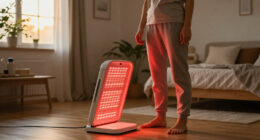
People searching for an infrared wellness heat lamp often find two products sold under similar language: near-infrared red light lamps and far-infrared heat lamps. They are compared because both use infrared wavelengths and promise wellness benefits, but they deliver different experiences. Near-infrared models direct light toward a treatment area; far-infrared models emphasize warmth, often over a broader area. That distinction affects what you feel, how you use the device, and what claims are reasonable to expect.

Get health and wellness essentials delivered free with Prime
- Fast, free delivery on millions of items
- Prime Video, Amazon Music and more included
- Member-only deals all year

Infrared Red Light Therapy Lamp 275W with Timer and Adjustable Height Stand
- ✔ Wattage: 275W
- ✔ Light type: Infrared
- ✔ Control: Remote controller
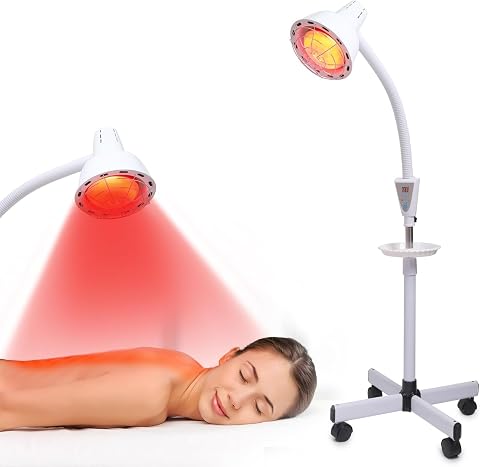
275W Infrared Light Therapy Lamp – Red Near-Infrared Heat Lamp for Joint and Muscle Pain, Adjustable Standing Lamp with Freely Ad…
- ✔ Power: 275W
- ✔ Light types: Near infrared, red light and far infrared
- ✔ Temperature: Freely adjustable
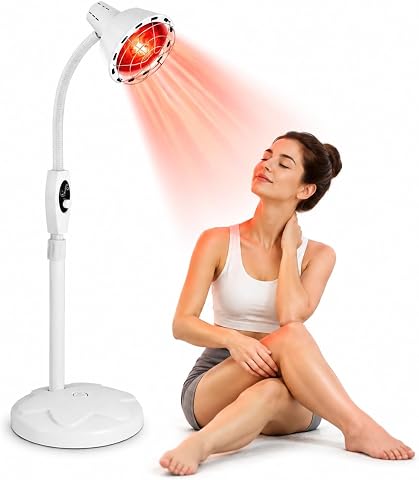
Infrared Heat Lamp – Far Infrared Therapy Lamp for Muscle Relaxation
- ✔ Wattage: 275W
- ✔ Light source: Far infrared
- ✔ Temperature range: 0–115°C / 32–239°F
Choose a near-infrared lamp if you want a focused light routine and are willing to follow device distance and exposure guidance. Choose a far-infrared lamp if warmth and relaxation are your main goals. Neither category should be treated as a substitute for medical care, and product claims vary widely. The best value depends on whether the device’s main output matches the benefit you actually want.
At a Glance
| Criteria | Near-infrared red light lamps | Far-infrared heat lamps | Winner |
|---|---|---|---|
| Primary purpose | Localized red and near-infrared light exposure | Radiant warmth and a heat-based relaxation experience | Depends |
| Sensation and coverage | Focused light over a selected body area; warmth varies by model | Designed to feel warming; coverage and intensity depend on lamp design | B |
| Evidence and claims | Some evidence supports photobiomodulation for specific uses, but results depend on wavelength and dose | Warmth can feel soothing, but broad wellness claims need scrutiny | A |
| Routine and setup | Requires attention to distance, session length, and eye protection guidance | Simple heat sessions, with distance and exposure controlled for comfort | Depends |
| Cost and value | Can be worthwhile for repeated, targeted use if specifications are credible | Worth paying for if comfortable, controlled warmth is the goal | Depends |
| Safety and comfort | Manage eye exposure, heat, and skin response; follow the manual | Avoid burns and overheating; extra care may be needed with impaired heat sensitivity | Tie |
Infrared Red Light Therapy Lamp 275W with Timer and Adjustable Height Stand
This is the easiest of the three to work into a repeatable home setup. Its wheeled, height-adjustable stand can move around a room, and the 360° head helps direct the lamp toward a chosen area without relocating the whole unit. A remote control and timer also make routine adjustments more convenient than the other two models’ described controls, which rely on a knob or unspecified temperature adjustment.Compared with the B0HLCQN1J5, this lamp puts more emphasis on operating convenience than on freely adjustable temperature. The latter may suit buyers who want to fine-tune heat, while this model’s remote and timer simplify changing brightness and session time. The B0HKHQDXNQ has a flexible hose and a protective mesh cover, but this lamp’s wheels may be more useful when moving a floor stand between nearby spots. The tradeoff is size: a wheeled stand needs room, and it remains tied to an outlet. Its listed specs also do not describe a mesh cover or adjustable temperature, so buyers seeking those particular features should compare the other picks.
Pros:
- Remote control for brightness and timer adjustments.
- Height-adjustable stand with wheels for repositioning.
- 360° rotatable head supports flexible aiming.
- 275W output for buyers seeking a full-size heat lamp.
Cons:
- Large floor stand takes up more room than a compact lamp.
- Corded operation requires an outlet near the treatment area.
- The listed features do not specify a protective mesh cover or variable temperature control.
Best for: Home users who want a movable floor stand, remote adjustments and a timer for targeted sessions.
Not ideal for: People with limited floor space, those needing cordless portability, or buyers who prioritize a protective mesh cover and explicit temperature control.
Bottom line: Choose this model when a remote, timer and wheeled stand matter more to your routine than fine temperature adjustment or a more compact footprint.
“Choose this model when a remote, timer and wheeled stand matter more to your routine than fine temperature adjustment or a more compact footprint.”
275W Infrared Light Therapy Lamp – Red Near-Infrared Heat Lamp for Joint and Muscle Pain, Adjustable Standing Lamp with Freely Ad…
For buyers who want to adjust the warmth rather than simply set a timer or brightness, this model is the most direct fit. It combines freely adjustable temperature with a tilting lamp head, letting users tailor the setup to different target areas. Its stable stand is described as suitable for home rooms and gyms, although the product details do not say that it has wheels or offer the remote control found on B0BRX5R8Z7.That distinction gives this pick a clear place between the lineup’s convenience-focused first choice and the flexible-hose B0HKHQDXNQ. The first lamp offers more specified control from across the room; this one gives temperature adjustment top billing. The third describes a mesh cover and fillable base, whereas this model’s safety information chiefly advises careful handling because the lamp can become very hot. Its 12-month basic warranty and 90-day bulb warranty are specified, but the shorter bulb coverage is a consideration for extended use. Choose it for control over warmth and a tilting head, while being prepared to manage hot surfaces carefully.
Pros:
- Freely adjustable temperature settings.
- Tilting head helps target different areas.
- Sturdy stand is described for stable placement.
- Warranty terms are stated: 12 months for the unit and 90 days for the bulb.
Cons:
- Lamp can become very hot, so careful handling is necessary.
- Bulb warranty is limited to 90 days.
- No remote or wheels are specified in the provided details.
Best for: Buyers who want adjustable temperature and a tilting head for directing the lamp at different body areas.
Not ideal for: Shoppers who want remote operation, a wheeled stand, or the more explicit mesh-cover and anti-scald features listed for B0HKHQDXNQ.
Bottom line: This is the best match when adjustable warmth is the deciding feature and you are comfortable with careful handling around a hot lamp.
“This is the best match when adjustable warmth is the deciding feature and you are comfortable with careful handling around a hot lamp.”
Infrared Heat Lamp – Far Infrared Therapy Lamp for Muscle Relaxation
This lamp stands apart through its flexible hose and telescopic height adjustment, rather than a remote or a stated freely adjustable temperature setting. The product lists a height range of roughly 49.6 to 63 inches and 360° positioning, which can help place the head around a seated or standing setup. A knob controls temperature, and the mesh cover, double-layer anti-scald design and fillable base are useful construction details for buyers comparing how a lamp is guarded and stabilized.Compared with B0BRX5R8Z7, this model trades wheeled mobility and remote convenience for a flexible arm and more explicit protective features. Against B0HLCQN1J5, it specifies a temperature range up to 115°C, but that high stated maximum reinforces the need to follow the supplied instructions and avoid contact with hot parts. Its base must be filled with water or sand, and assembly is required; that adds setup work compared with a stand whose details do not call for filling. The product is described for cosmetic and wellness use, not medical diagnosis or treatment. It is a distinctive choice for careful positioning, but its stable placement depends on a flat surface and a properly prepared base.
Pros:
- Flexible hose and 360° angle adjustment aid precise positioning.
- Height adjusts from about 49.6 to 63 inches.
- Mesh cover and double-layer anti-scald design are specified.
- Water- or sand-fillable base can add stability.
Cons:
- Requires assembly and a flat, stable placement surface.
- Base needs filling with water or sand before use.
- Temperature range reaches 115°C, so hot-lamp handling requires care.
Best for: Buyers who value a flexible positioning hose, a mesh cover and a base they can weight with water or sand.
Not ideal for: Anyone seeking a remote, wheels, minimal assembly, or a lamp that can be used without preparing a stable floor position.
Bottom line: Pick this model for flexible aiming and its listed protective details if you can accommodate setup and careful placement.
“Pick this model for flexible aiming and its listed protective details if you can accommodate setup and careful placement.”
As an Amazon Associate we earn from qualifying purchases.
Key Differences
The most meaningful difference is the intended output. Near-infrared red light devices are typically bought for light exposure directed at a particular area. Far-infrared heat lamps are bought for warmth. A lamp’s marketing may blur those purposes, but a warm sensation alone does not show that it delivers a useful light dose, and a red glow does not establish that it provides comfortable, broad heating.
Neither label guarantees a particular outcome. Evidence for light-based treatments is specific to the condition, wavelength, power, and exposure protocol; it does not support every general wellness claim. Heat may provide temporary comfort, but it should not be confused with treating an underlying condition or producing lasting health changes. Check technical specifications and safety directions, and consult a clinician about persistent symptoms or health conditions affected by heat or light.
For value, pay for the output you plan to use consistently. A targeted light device may justify a higher price for someone with a clear, evidence-informed use and transparent specifications. A simpler heat lamp may be the better buy for someone seeking comfortable warmth. Paying extra for vague claims, decorative features, or the word “infrared” alone is difficult to justify.
Detailed Comparison
Primary purpose (major difference)
Near-infrared lamps are intended to provide light to a defined area, while far-infrared heat lamps prioritize warming the body or a body region. Neither is a universal wellness device. The winner depends on the desired result: A fits targeted light use; B fits heat and comfort.
Sensation and coverage (Far-infrared heat lamps wins — moderate)
Far-infrared lamps have the clearer advantage when the desired experience is warmth. Near-infrared devices can also produce heat, but warmth is not their defining purpose, and the sensation varies by product. Coverage is also model-specific: compare the usable treatment area and recommended distance rather than assuming a lamp warms or illuminates a whole body.
Evidence and claims (Near-infrared red light lamps wins — moderate)
Near-infrared red light has a stronger basis for specific light-based applications than general heat-lamp wellness claims, but evidence does not validate every advertised benefit. The product must deliver an appropriate wavelength and dose for the intended use. Far-infrared warmth may feel soothing, yet that sensation is not proof of a broader therapeutic effect. A has a moderate edge for evidence-led, specific use.
Routine and setup (minor difference)
Both require following the manufacturer’s directions, but their routines differ. A typically calls for consistent positioning, distance, session length, and attention to eye exposure. B calls for comfortable distance and heat monitoring to avoid overheating. There is no universal winner: A asks for more light-dose discipline, while B makes comfort the practical guide.
Cost and value (moderate difference)
Prices vary substantially, and a higher price does not guarantee better results. A is better value when its specifications support a defined light routine that the buyer will use. B is better value for someone who simply wants a warming session. Choose by credible output, build quality, warranty, and safe controls; skip premium pricing based only on expansive claims.
Safety and comfort (moderate difference)
Neither category is risk-free. With A, follow eye-safety instructions and stop if exposure causes discomfort or irritation. With B, prevent burns and excessive heat, and take care if sensation or circulation is reduced. Since each has different risks and safe use depends on the person and device, neither wins overall. Seek medical advice when a condition or medication may affect light or heat sensitivity.
Near-infrared red light lamps: Pros and Cons
Pros:
- Designed for targeted light exposure
- More relevant when a specific light-based use is the goal
- Specifications can be compared by wavelength and output
Cons:
- Benefits depend on the device and exposure protocol
- May not provide the broad warmth some buyers want
- Requires attention to positioning and eye-safety directions
Far-infrared heat lamps: Pros and Cons
Pros:
- Prioritizes a noticeable warming experience
- Can suit simple relaxation routines
- Does not require buying a light device for a use the buyer does not want
Cons:
- Warmth alone does not establish therapeutic benefit
- Heat intensity and coverage vary by design
- Overheating and burns are practical risks
Who Should Choose What
Choose Near-infrared red light lamps if:
- You want localized near-infrared or red light exposure for a specific, evidence-informed purpose.
- You are prepared to follow the specified distance, session, and eye-safety guidance.
- You can verify the device’s wavelength and output rather than relying on broad wellness claims.
Choose Far-infrared heat lamps if:
- Your main goal is a comforting warming sensation.
- You prefer heat sessions and will monitor your skin and comfort.
- The lamp offers clear controls, safety guidance, and a price that makes sense for regular use.
Skip both if: Skip both if you expect a lamp to diagnose or treat a medical condition, cannot use heat or light safely, or cannot find credible specifications and clear safety instructions.
Value for Money
Pay more for a near-infrared lamp only when you have a defined use and the manufacturer provides enough information to judge wavelength, output, treatment area, and safe exposure. In that case, the higher cost may buy a more suitable device and a repeatable routine. If warmth is all you want, paying a premium for photobiomodulation language adds little value. A far-infrared heat lamp can be the sensible purchase when it provides comfortable, controllable heat at a fair price. In either category, warranty and clear instructions matter more than ambitious claims.
Final Verdict
For buyers seeking targeted light exposure, choose a near-infrared red light lamp with transparent specifications and a plausible use case. For buyers seeking warmth and relaxation, choose a far-infrared heat lamp with controllable intensity and clear burn-prevention guidance. The deciding factor is whether light or heat is the actual goal. Most shoppers should avoid paying for a hybrid-sounding wellness promise unless the device clearly explains both outputs and how to use them safely.
Frequently Asked Questions
Are near-infrared red light lamps the same as far-infrared heat lamps?
No. They use different parts of the infrared spectrum and are generally designed for different experiences: targeted light exposure versus radiant warmth. Product labels can be imprecise, so check specifications and instructions.
Which type is better for relaxation?
If relaxation means feeling warm, a far-infrared heat lamp is the more direct fit. Comfort varies by person and device, and sessions should stop if the heat becomes uncomfortable.
Does a red glow prove a lamp provides an effective treatment?
No. Appearance alone does not establish wavelength, output, or dose. Look for technical details and a protocol relevant to the intended use, and treat broad claims cautiously.
Is the more expensive lamp worth buying?
Only if its output and safety features match your intended routine. A higher price can be worthwhile for verified specifications and dependable controls, but it does not guarantee better health results.