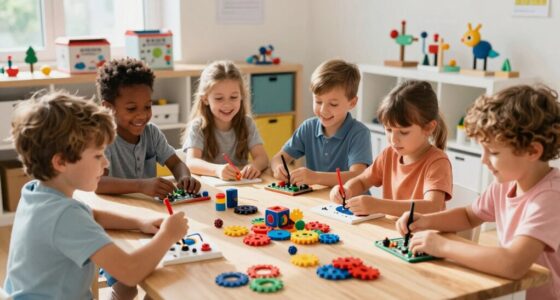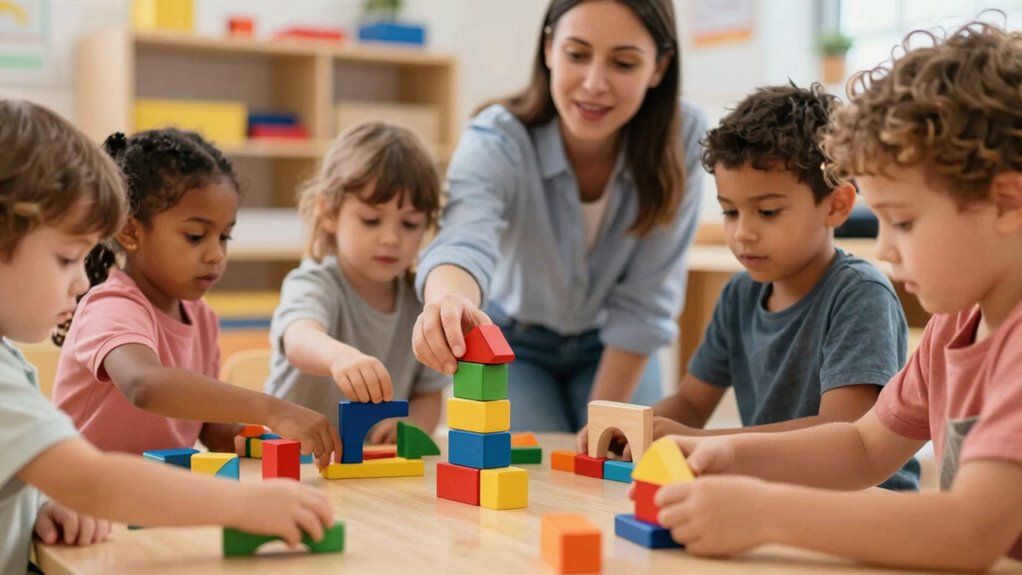

Block play helps you support your child’s early math and engineering skills by boosting their spatial reasoning, problem-solving, and understanding of patterns. As they experiment with construction, they learn about balance, measurement, and relationships between objects. It also encourages creativity, teamwork, and persistence. By exploring these concepts through play, your child builds a strong foundation for more advanced math and engineering ideas. Keep exploring to discover more ways to nurture their development.

Get health and wellness essentials delivered free — and shop member deals
- Fast, free delivery on millions of items
- Access to Prime Big Deal Days deals on October 6–7
- Prime Video, Amazon Music and more included
Key Takeaways
- Develops spatial reasoning and understanding of object relationships essential for engineering and geometry concepts.
- Encourages problem solving and experimentation, fostering critical thinking and design skills.
- Introduces measurement, symmetry, and pattern recognition foundational to early math learning.
- Promotes visualization skills necessary for engineering design and understanding three-dimensional structures.
- Uses natural materials and models to explore engineering principles, stability, and sustainability.

Block play is a powerful tool for supporting young children’s early math and engineering skills. When you encourage children to build and manipulate blocks, you’re helping them develop essential cognitive abilities like spatial reasoning and problem solving. Spatial reasoning involves understanding how objects relate to each other in space—how they fit, move, and balance—which is fundamental for many math concepts and engineering tasks. As children stack blocks, create structures, or arrange pieces in different orientations, they learn to visualize how components fit together, fostering their ability to think in three dimensions. This mental exercise is a core part of early geometry and spatial awareness, laying the groundwork for more advanced math skills later on. Developing spatial reasoning through block play also supports the understanding of relationships between objects, which is crucial in various STEM fields. Problem solving arises naturally during block play because children often encounter challenges that require creative thinking and persistence. For example, when trying to build a bridge or a tower that won’t topple, they experiment with different arrangements, test stability, and adjust their designs. These experiences teach them to analyze situations, consider multiple solutions, and evaluate what works best. Such problem-solving activities build their confidence in tackling complex tasks and promote critical thinking. You’ll notice children learning to anticipate consequences, plan ahead, and refine their ideas—all skills that transfer to math and engineering concepts as they grow. By providing open-ended opportunities for block play, you enable children to explore and discover at their own pace. As they build, they begin to recognize patterns, compare sizes, and understand concepts like symmetry and balance. These foundational ideas are essential for understanding measurements, fractions, and basic algebra later in school. Additionally, when children collaborate during block activities, they learn to communicate their ideas, negotiate, and share resources, which enhances their social-emotional development and teamwork skills—both important in engineering fields. Encouraging children to set their own goals during block play—such as creating the tallest tower or designing a stable structure—helps them develop a sense of achievement and motivation. You can extend their learning by asking questions like, “What do you think will happen if you try this?” or “How can you make it stronger?” These prompts push children to think critically and improve their problem-solving strategies. Moreover, understanding the importance of visualization in engineering can help children connect their block play to real-world design challenges. Incorporating natural materials into block activities can further enrich their understanding of engineering concepts and sustainability. Recognizing the influence of artistic movements like Cubism on visual perception can also inspire children to see different perspectives and develop innovative ideas. In addition, understanding the role of models and prototypes in engineering can help children appreciate how ideas are tested and refined before final implementations. Overall, block play isn’t just about fun; it’s a dynamic activity that nurtures spatial reasoning, fosters problem solving, and builds a solid foundation for early math and engineering understanding.
wooden building blocks set for kids
As an affiliate, we earn on qualifying purchases.
As an affiliate, we earn on qualifying purchases.
Frequently Asked Questions
How Do Different Types of Blocks Influence Learning Outcomes?
Different types of blocks influence your child’s learning outcomes by offering varied shapes and textures. For example, square blocks help develop stability, while irregular shapes encourage creativity. Using different stacking techniques with these block shapes boosts fine motor skills and problem-solving abilities. As your child experiments with stacking, they learn about balance and spatial relationships, fostering early engineering concepts. The diversity in blocks keeps play engaging and educational, promoting well-rounded development.
What Age Is Most Suitable for Introducing Block Play?
You can introduce block play during early childhood, typically around ages 2 to 3, as children reach key developmental milestones. At this stage, they develop fine motor skills, spatial awareness, and problem-solving abilities, making block play highly beneficial. Starting early encourages curiosity, creativity, and foundational math skills, helping children explore engineering concepts naturally as they grow. Always observe their individual progress to guarantee the activities match their developmental readiness.
How Can Parents Encourage Math Skills Through Block Activities?
Ever wondered how to boost your child’s math skills through play? You can encourage this by guiding them in building with blocks, emphasizing patterns, symmetry, and counting. Ask questions like, “How many blocks do you need?” to foster confidence and problem-solving. This not only builds their math skills but also fosters creativity, making learning fun. Your involvement turns simple block play into a powerful educational tool.
Are There Any Safety Concerns With Certain Types of Blocks?
You should always check the material safety of blocks before giving them to your child, especially if they’re made from plastic or painted with non-toxic finishes. Be cautious of choking hazards with small blocks or pieces, and supervise your child during play. Opt for blocks that are age-appropriate and free from sharp edges. Ensuring material safety and avoiding choking hazards help create a safe, fun learning environment for your little one.
How Does Block Play Compare to Digital Tools for Math Learning?
Block play offers tactile, hands-on learning that digital tools like virtual manipulation and interactive simulations can’t fully replicate. While digital tools provide dynamic, visual representations of math concepts, they lack the physical engagement that helps you develop spatial reasoning and fine motor skills. Combining both approaches gives you a richer understanding of math, as you can explore concepts in a concrete way with blocks and reinforce them through engaging virtual activities.
As an affiliate, we earn on qualifying purchases.
Conclusion
As you guide children through block play, you’re planting seeds of curiosity that grow into towering trees of understanding. These blocks become stepping stones across a stream of discovery, building bridges to math and engineering skills. With each stack and structure, you’re painting a vibrant mural of problem-solving and creativity. Watch as their imaginations soar, transforming simple blocks into castles of knowledge, turning play into a powerful journey of early learning.
early childhood engineering blocks
As an affiliate, we earn on qualifying purchases.
As an affiliate, we earn on qualifying purchases.
pattern recognition building blocks
As an affiliate, we earn on qualifying purchases.
As an affiliate, we earn on qualifying purchases.
Cold & flu season Picks
humidifiers
As an affiliate, we earn on qualifying purchases.