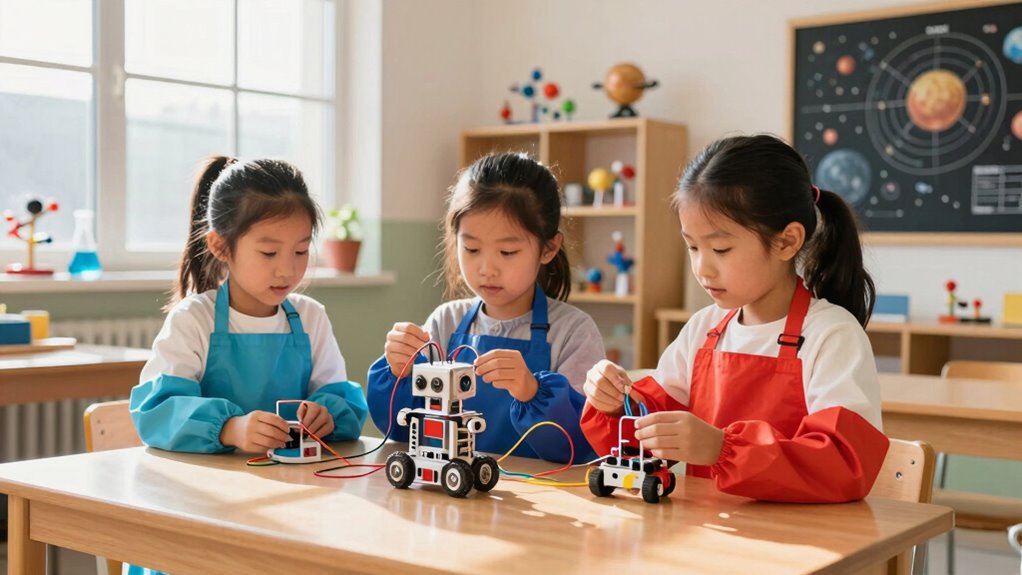

To encourage girls through early STEM play, create a supportive and curiosity-driven environment by celebrating problem-solving and resilience. Offer a variety of inclusive toys, like science kits and engineering sets, and use books that showcase diverse female role models. Join children in hands-on activities and ask open-ended questions to spark thinking. Avoid gender stereotypes and let girls choose activities based on their interests. Keep exploring these strategies to help build confidence and inspire lifelong passion for STEM.
Key Takeaways
- Offer diverse STEM toys and materials, emphasizing exploration and creativity without gender labels.
- Model enthusiasm and curiosity about STEM activities, demonstrating that all children can excel.
- Use inclusive language and celebrate efforts, focusing on problem-solving and resilience over success or failure.
- Introduce role models and stories featuring women and girls in STEM to inspire confidence and interest.
- Create a supportive environment that encourages questions, experimentation, and sustained curiosity in STEM fields.

Your participation in your child’s playtime sends a powerful message. When you show enthusiasm for building, experimenting, or problem-solving, you reinforce that these activities are not gender-specific. For example, if your child shows an interest in constructing with blocks or exploring how things work, join in and express excitement. Avoid framing certain toys or activities as “for boys” or “for girls.” Instead, present a variety of options and let her choose what excites her. This approach helps her develop a positive attitude toward STEM topics, free from societal stereotypes. Be mindful of the toys and resources you provide; opt for science kits, engineering sets, or books that highlight diverse scientists, engineers, and innovators. These resources help normalize the idea that girls can excel in STEM just as much as boys. Incorporating natural curiosity into her play can further deepen her interest and understanding of STEM concepts. Additionally, understanding the importance of color accuracy in visual learning tools can enhance her engagement with educational materials, making STEM activities more appealing and realistic. Recognizing the role of early education in shaping perceptions about STEM can also contribute to her long-term interest and success. Creating a supportive environment where she feels encouraged to explore and ask questions is essential for nurturing her STEM potential.
Parental involvement is also about creating a supportive environment where curiosity is celebrated. Ask open-ended questions that encourage her to think critically, like “How do you think this works?” or “What would happen if we tried this differently?” Celebrate her problem-solving efforts and resilience, rather than just the end result. This builds her confidence and helps her view failures as opportunities to learn. Furthermore, exposing her to role models—women and girls who have succeeded in STEM fields—through stories, videos, or community events can plant seeds of inspiration. Seeing relatable figures in these roles can inspire her to pursue her interests without feeling limited by gender expectations.
Ultimately, your active encouragement and awareness of gender stereotypes can make a *meaningful* difference. When you nurture her natural curiosity and provide diverse, engaging opportunities, you help her develop a lifelong passion for STEM. Your involvement not only boosts her confidence but also helps her see herself as a future scientist, engineer, or innovator—breaking down barriers and opening doors for her to thrive in any field she chooses.
As an affiliate, we earn on qualifying purchases.
Frequently Asked Questions
How Early Should Girls Start STEM Activities?
Girls should start STEM activities as early as possible, ideally before age three, to foster curiosity and counteract gender stereotypes. As a parent, your encouragement is crucial—introduce toys, books, and activities that make STEM fun and accessible. By showing enthusiasm and support early on, you help build confidence and interest, making it more likely she’ll pursue STEM subjects later, breaking down societal barriers and inspiring her to explore her potential.
What Are Some Age-Appropriate STEM Toys for Girls?
You should choose age-appropriate STEM toys that promote creative play and problem-solving skills. For young girls, consider building blocks, simple robotics kits, or science experiment sets designed for their age. These toys encourage curiosity and critical thinking while making STEM fun. As they grow, introduce more complex puzzles and coding games. Always pick toys that challenge her creatively, helping her develop confidence and a love for STEM from an early age.
How Can Parents Support Girls’ Interest in STEM?
You can support girls’ interest in STEM by actively role modeling enthusiasm for science, technology, engineering, and math. Share your own experiences and highlight inspiring female STEM figures. Get involved in community events like workshops or science fairs to show that STEM is accessible and fun. Encouraging curiosity, asking questions, and celebrating their achievements reinforce their confidence and passion, helping them see a future where they belong in STEM fields.
Are There Culturally Specific Approaches to Encourage Girls in STEM?
Imagine planting a seed in different gardens; each garden has its unique soil and climate. Cultural norms and traditional beliefs shape these environments, influencing how girls see STEM. To encourage them, you must nurture each seed with respect for these cultural roots, offering tailored encouragement that aligns with local values. By doing so, you help girls grow confident in STEM, regardless of cultural expectations, fostering diverse future innovators.
How Do I Address Gender Stereotypes in STEM Play?
To address gender bias and stereotype challenges in STEM play, you should actively challenge stereotypes by highlighting female role models and emphasizing that STEM is for everyone. Encourage girls to explore a variety of activities without gendered expectations. Create an inclusive environment where questions are welcomed, and successes are celebrated equally. By doing so, you foster confidence and help dismantle stereotypes, empowering girls to pursue STEM with enthusiasm and belief in their abilities.
As an affiliate, we earn on qualifying purchases.
Conclusion
By fostering curiosity and providing engaging STEM play opportunities, you can inspire girls to pursue their passions fearlessly. Remember, even in an age of yore, pioneers like Ada Lovelace blazed trails in tech, proving that nurturing early interest leads to future breakthroughs. So, keep encouraging, exploring, and dreaming big—because empowering girls today paves the way for a brighter, more innovative tomorrow. Embrace the journey, and let curiosity be your guiding star.
diverse female role model STEM books
As an affiliate, we earn on qualifying purchases.
As an affiliate, we earn on qualifying purchases.
As an affiliate, we earn on qualifying purchases.