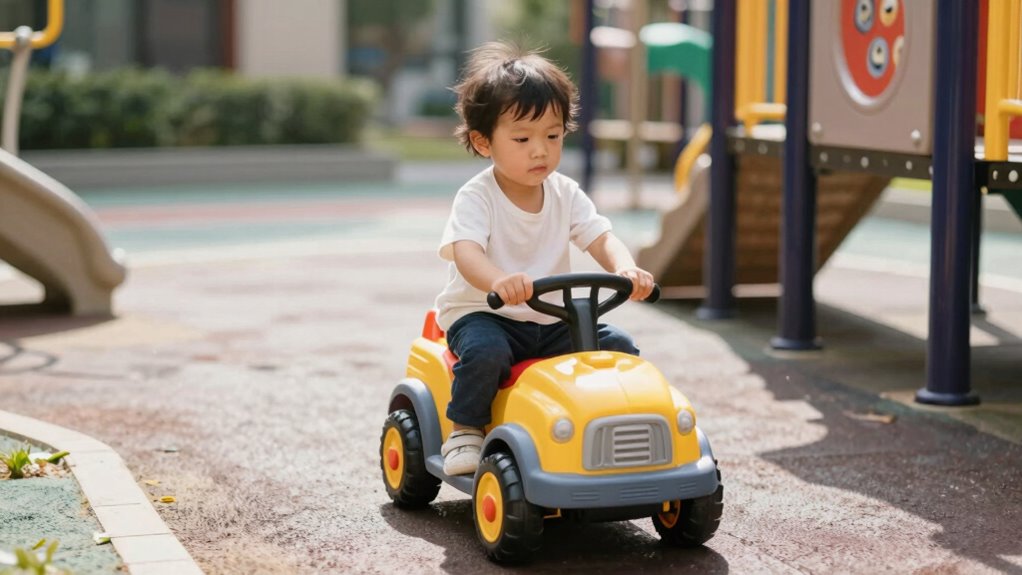

Ride-on toys help you develop your child’s spatial awareness by encouraging active exploration. As they push, steer, and navigate uneven terrain or around obstacles, they learn to judge distances and understand their body’s position in space. These activities also improve coordination and fine motor skills. By controlling the toy, your child gains confidence in their spatial judgments, which supports overall growth. Keep exploring to discover even more ways ride-on toys boost spatial skills.

Get health and wellness essentials delivered free — and shop member deals
- Fast, free delivery on millions of items
- Access to Prime Big Deal Days deals on October 6–7
- Prime Video, Amazon Music and more included
Key Takeaways
- Riding ride-on toys encourages children to navigate and control movement, enhancing spatial judgment and awareness.
- Maneuvering around obstacles and uneven terrains refines depth perception and spatial reasoning skills.
- Turning, stopping, and adjusting speed develop understanding of body-environment relationships.
- Sharing space and taking turns promote social awareness of spatial boundaries.
- Exploring diverse outdoor environments fosters adaptability and recognition of environmental cues.
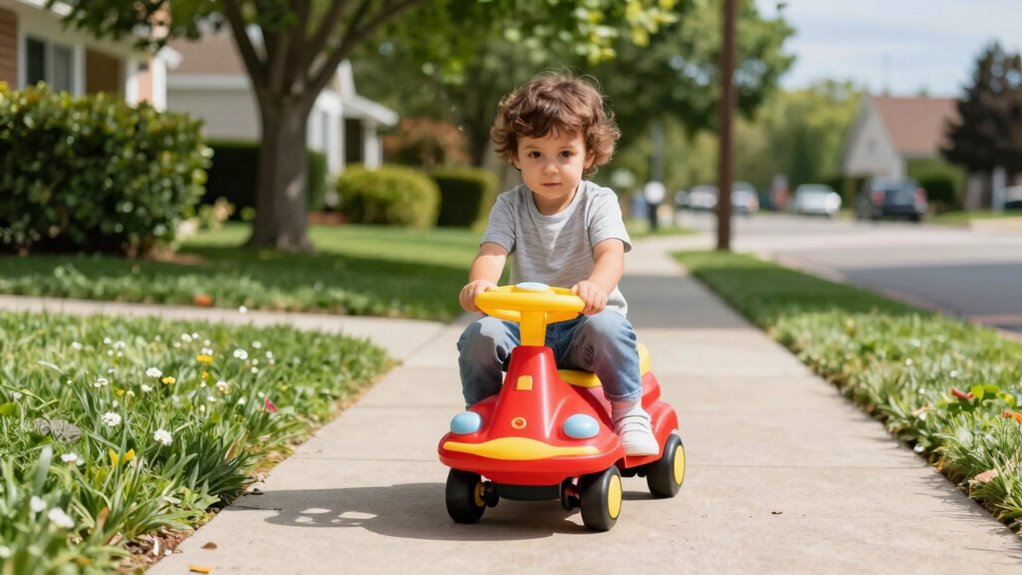
Ride-on toys are more than just fun playthings—they can play a significant role in developing a child’s spatial awareness. When you let your child hop onto a ride-on, they immediately start engaging in activities that boost motor skill development. As they push, steer, and balance, they learn how their body moves through space. This active movement helps them understand where their body is in relation to objects around them, which is a fundamental element of spatial awareness. Outdoor play with ride-on toys amplifies these benefits because the open environment offers more space for exploration and movement. Your child can maneuver freely, experiment with turning, stopping, and adjusting their speed, all of which enhance their understanding of spatial relationships.
Using ride-on toys outdoors encourages your child to navigate different terrains, slopes, and obstacles, further honing their spatial judgment. When they drive over uneven ground or around cones, they learn to judge distances and improve their coordination. These experiences are vital for developing a sense of depth and spatial positioning, which are foundational to many everyday activities like crossing the street or playing sports. As your child masters controlling the ride-on, they also develop better hand-eye coordination and fine motor skills, which are essential to overall motor skill development. These skills don’t just stop at riding; they translate into improved writing, drawing, and other precise movements learned later in childhood.
Furthermore, outdoor play with ride-on toys introduces your child to social spatial awareness. They learn how to share space with other children, take turns, and navigate around peers, all of which deepen their understanding of spatial boundaries and social cues. This interaction fosters a sense of spatial competence that extends beyond physical movement. Engaging in diverse environments helps children adapt to different settings, which is an important aspect of developing a well-rounded spatial awareness. Incorporating a variety of visual stimuli and landscaping can further challenge and refine their perception of spatial relationships. Recognizing the importance of environmental cues in their surroundings further supports their development of spatial reasoning. Exposure to different environments and cues is essential for cultivating a well-developed spatial understanding, especially as they encounter new physical and social scenarios. As they become more confident in their ability to control their ride-on, their overall spatial awareness grows stronger, helping them become more aware of their surroundings and better prepared for complex physical and social environments.
In essence, riding outside on a well-chosen ride-on toy isn’t just about having fun; it’s about creating opportunities for your child to develop critical motor skills and spatial understanding naturally. With every turn and stop, they’re actively learning how their body and environment relate, setting a strong foundation for future coordination, balance, and spatial reasoning. It’s an engaging, dynamic way to support their growth while they enjoy the outdoors.
As an affiliate, we earn on qualifying purchases.
Frequently Asked Questions
At What Age Are Ride-On Toys Most Beneficial for Spatial Skills?
You’ll find ride-on toys most beneficial for spatial skills between ages 1 and 3. During this stage, they boost motor skill development as your child learns to control movement and balance. Plus, riding with others encourages social interaction, helping them understand personal space and navigation. This combination of physical activity and social play considerably enhances their spatial awareness, setting a strong foundation for future coordination and interpersonal skills.
How Do Different Ride-On Toy Designs Influence Spatial Awareness Development?
Different ride-on toy designs are like keys opening your child’s spatial awareness. For example, larger, multi-directional models challenge their balance coordination and motor planning, helping them navigate better. Conversely, simpler, smaller designs focus on foundational skills. By choosing varied structures, you actively boost your child’s ability to judge distances, coordinate movements, and plan routes—building a solid spatial awareness foundation that’s essential for their overall development.
Can Ride-On Toys Help Children With Developmental Delays?
Yes, ride-on toys can help children with developmental delays by boosting motor skill development and encouraging social interaction. When you let your child ride, they practice coordination and balance, which are vital for movement. Plus, riding with others or in group settings fosters social skills, confidence, and understanding of personal space. These toys create fun opportunities for growth, helping children develop essential abilities in a supportive, engaging environment.
Are There Safety Considerations for Enhancing Spatial Skills With Ride-On Toys?
Think of ride-on toys as your child’s chariot, but safety comes first. To enhance spatial skills safely, follow essential safety precautions like wearing helmets and ensuring sturdy, well-maintained toys. Supervision guidelines are key—stay close, monitor your child’s movements, and set clear boundaries. This way, your little explorer can build spatial awareness confidently without unnecessary risks, turning playtime into a safe, educational adventure.
How Do Indoor Versus Outdoor Ride-On Toys Affect Spatial Learning?
Indoor ride-on toys promote motor skill development and sensory integration in a controlled environment, helping you focus on balance and coordination without outdoor distractions. Outdoor ride-on toys, however, expose your child to varied terrains and spatial challenges, enhancing their ability to navigate and adapt. Both settings support spatial learning, but outdoor play offers richer opportunities for real-world experience, fostering better spatial awareness through diverse sensory inputs and movement challenges.
As an affiliate, we earn on qualifying purchases.
Conclusion
As you watch your child explore with ride-on toys, it’s like planting seeds in a garden of spatial awareness. These toys help your little one navigate their world, building confidence and coordination with every turn and stop. Just as a compass guides a sailor through uncharted waters, ride-on toys steer your child toward a future filled with spatial understanding. Embrace these playful adventures—they’re the building blocks of a confident, aware explorer.
kids balance and steering ride-on toy
As an affiliate, we earn on qualifying purchases.
As an affiliate, we earn on qualifying purchases.
children's ride-on obstacle course
As an affiliate, we earn on qualifying purchases.
As an affiliate, we earn on qualifying purchases.
Fall Picks
fall essentials
As an affiliate, we earn on qualifying purchases.