
TL;DR

Get health and wellness essentials delivered free with Prime
- Fast, free delivery on millions of items
- Prime Video, Amazon Music and more included
- Member-only deals all year
Boston-based Pilates instructor Julie Erickson recommends a three-move sequence—roll up and roll down, swan prep, and spine twist—for people seeking to improve mobility and posture. Those benefits and the claim that the routine is the “quickest” option are the instructor’s guidance, not findings supported by comparative evidence in the report.
Boston-based Pilates instructor Julie Erickson recommends a three-exercise sequence of roll up and roll down, swan prep, and spine twist for people looking to improve posture and ease stiffness. The routine, published by Fit&Well, is presented as an option for people who spend long periods sitting or looking down at phones. The supplied report does not provide evidence that it is the fastest approach or quantify its effects.
Erickson, founder of Endurance Pilates and Yoga, recommends doing 8–10 roll ups and roll downs, five swan preps, and five spine twists on each side. The sequence combines spinal movement, back extension and torso rotation. Fit&Well says regular practice may help restore mobility and strengthen the back, making it easier to sit and stand upright; that is the report’s description of the expected benefit, not a measured result included in the source material.
For the roll up and roll down, sit with legs extended and arms reaching forward. Roll the torso down toward the floor, reach the arms overhead, then curl back up and fold forward over the legs. The report suggests making the movement easier by rolling down only partway or securing the feet under a strap or couch.
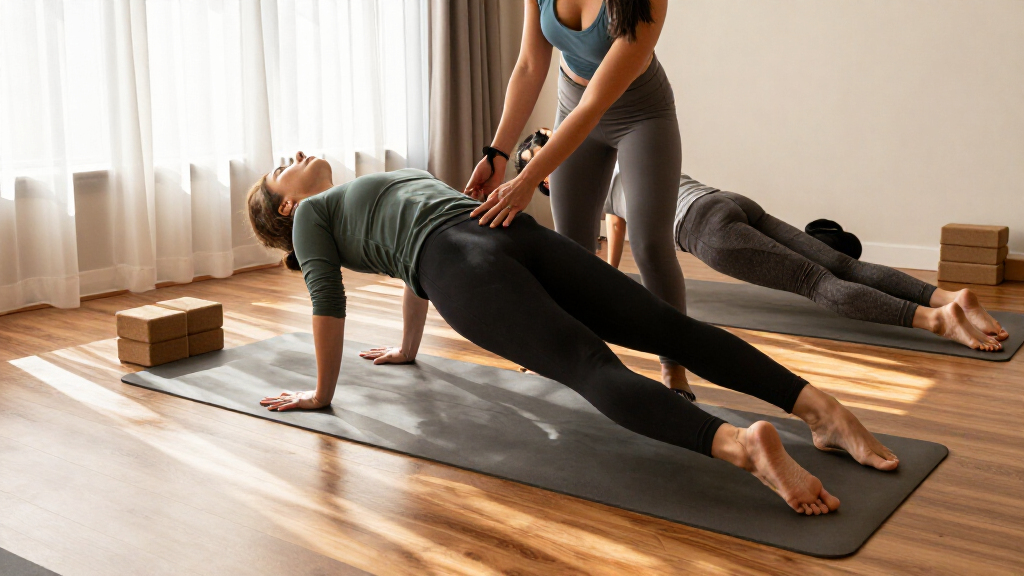
For swan prep, lie face down with palms beside the ribs and elbows bent. Press into the hands to lift the chest while drawing the shoulders back, then lower slowly. The spine twist is performed seated, with the legs extended and arms open: rotate the ribcage to one side while keeping the hips still, return to centre, and repeat on the other side. The Fit&Well instructions do not give a time commitment or a weekly schedule.
A Short Routine for Desk Stiffness
The sequence includes three described movements that require no specialist equipment. The report also provides an easier variation for the roll up. It does not state how long the exercises take or compare them with other forms of movement.
Erickson presents the routine as a way to work on mobility and back strength. The source material includes no trial, measurement or comparison showing that it improves posture faster than other exercises. It also does not define how improvement or stiffness would be assessed.
As an affiliate, we earn on qualifying purchases.
The Three Movements in the Sequence
Fit&Well frames the routine around the effects that prolonged desk work and phone use can have on posture. Erickson’s proposed sequence includes rolling through the spine, lifting the chest while face down, and rotating the ribcage while seated.
The exercises are presented with repetition counts rather than as a timed workout: 8–10 roll ups and roll downs, five swan preps and five twists per side. The source includes modifications for the roll up and an option to increase the swan prep’s difficulty by lifting higher or straightening the arms. It does not provide further guidance on progression, frequency or how long to continue the routine.
“The quickest way to improve your posture and reduce stiffness”
— Julie Erickson, as quoted in the Fit&Well report
As an affiliate, we earn on qualifying purchases.
Evidence and Practice Schedule Unspecified
The source material does not say how quickly results might appear, how often the sequence should be practiced, or what evidence supports describing it as the quickest way to improve. It also provides no study, comparison group or measured posture or stiffness outcomes. The speed and scale of any benefit therefore cannot be established from the report.
The instructions do not discuss who should avoid the exercises, how to adapt them for particular health conditions, or what to do if a movement causes pain. The supplied material does not report injuries or other adverse effects. Readers with health concerns or uncertainty about whether an exercise is suitable can seek guidance from a qualified health professional.
adjustable Pilates resistance band
As an affiliate, we earn on qualifying purchases.
As an affiliate, we earn on qualifying purchases.
What Readers Can Verify
The report provides movement instructions and repetition counts but does not set out a research follow-up or a specific next milestone. No trial results or additional evidence are included in the supplied source material, so claims about speed or effectiveness remain unverified there.
A clearer assessment would require details the report does not provide, such as a defined practice schedule, a timeframe and measured changes in mobility, stiffness or posture. The three movements are presented as Erickson’s recommended sequence; the report does not establish them as the fastest method.
As an affiliate, we earn on qualifying purchases.
Key Questions
Which three Pilates exercises does Julie Erickson recommend?
She recommends roll up and roll down, swan prep, and spine twist. Fit&Well lists 8–10 repetitions of the roll up and roll down, five swan preps, and five spine twists on each side.
Does the report prove this is the quickest way to improve posture?
No. The report attributes the recommendation to instructor Julie Erickson but gives no comparative study or measured results establishing that it is faster than other approaches.
How often should the sequence be done?
The supplied report says the routine should be practiced regularly but does not specify a weekly frequency or duration.
What modification does the report suggest for the roll up?
It suggests rolling down only halfway or securing the feet under a strap or couch to make the movement easier.
Source: rss
Halloween Picks
halloween
As an affiliate, we earn on qualifying purchases.