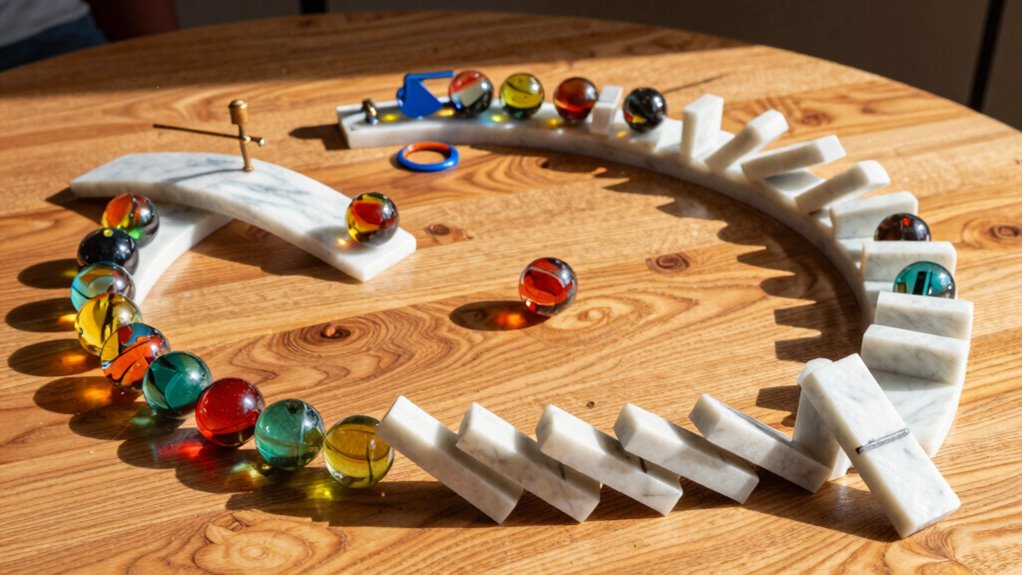

Marble runs teach cause and effect naturally by showing how small changes in design can impact the marble’s movement and outcome. When you raise or lower ramps, your adjustments directly affect speed and trajectory. Hitting obstacles or switches creates immediate results, illustrating cause and effect clearly. By experimenting and observing how modifications influence the system, you’ll see how different factors interact. Keep exploring, and you’ll discover even more about how actions shape outcomes in these dynamic setups.

Get health and wellness essentials delivered free — and shop member deals
- Fast, free delivery on millions of items
- Access to Prime Big Deal Days deals on October 6–7
- Prime Video, Amazon Music and more included
Key Takeaways
- Modifying ramp height or angles demonstrates how changes cause variations in marble speed and trajectory.
- Hitting obstacles or switches shows immediate cause-and-effect outcomes in the marble’s movement.
- Small design adjustments reveal how specific modifications impact overall system performance.
- Observing energy transfer from potential to kinetic energy illustrates cause-and-effect in physics concepts.
- Testing different configurations helps learners understand how variables interact and influence results.
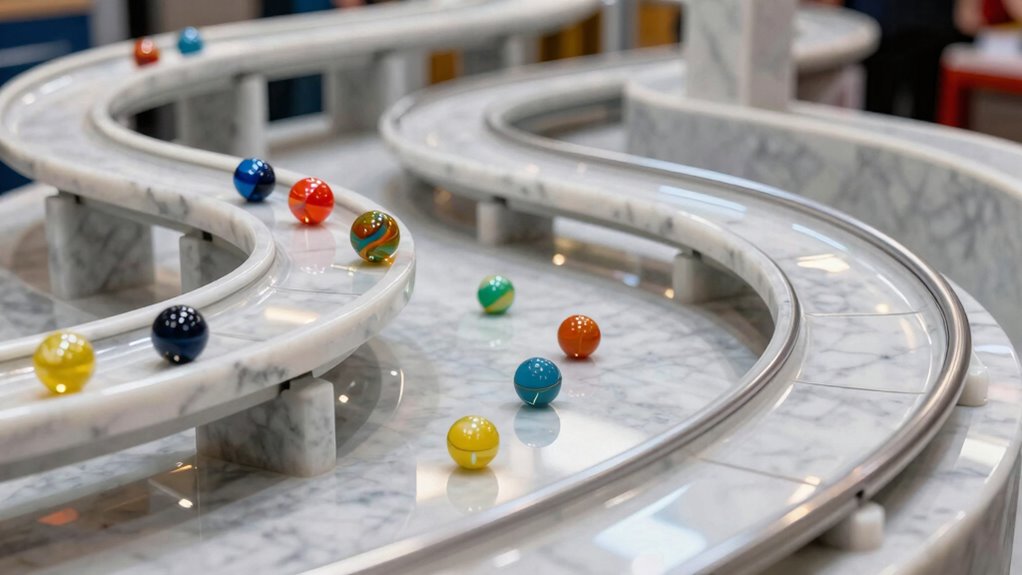
Marble runs are more than just fun, colorful constructions—they’re also powerful tools for teaching cause and effect. When you set up a marble run, you’re engaging with fundamental physics principles without even realizing it. Gravity pulls the marble downward, demonstrating how force influences motion. As the marble accelerates, you observe concepts like acceleration and momentum in action. When designing a run, you’re also applying engineering design skills—carefully constructing slopes, curves, and obstacles to control the marble’s path. Each element you add or change impacts how the marble moves, providing immediate visual feedback on cause and effect.
As you experiment with different configurations, you notice how altering the height of a ramp changes the speed of the marble. If you raise the starting point, the marble gains more potential energy, resulting in a faster descent. This directly illustrates the relationship between energy and motion, a core physics principle. When the marble hits an obstacle or a switch, you see cause and effect unfold in real time. A slight adjustment to the angle of a slope might mean the difference between a successful landing and a missed target. These small modifications help you understand how variables interact and how they can be manipulated to achieve a specific outcome.
Building a marble run also encourages you to think critically about engineering design. You learn to contemplate stability, balance, and the flow of energy throughout the structure. When a part of the run causes the marble to fall off or get stuck, you analyze the problem and refine your design. This iterative process teaches you that engineering isn’t just about creativity; it’s about understanding how different elements work together in a system. You learn to anticipate how each change will ripple through the entire structure, reinforcing cause-and-effect relationships. Additionally, observing how support structures provide stability helps you understand the importance of balance in engineering. Recognizing the role of physics principles in your design enhances your ability to predict outcomes and troubleshoot issues effectively. Integrating scientific concepts such as energy transfer and force allows for a deeper comprehension of how real-world systems function.
Every time you test your marble run, you’re practicing scientific thinking—predicting outcomes based on your design, observing what actually happens, and adjusting accordingly. It’s a dynamic way to grasp physics principles and engineering design simultaneously. The beauty of marble runs is that they make abstract concepts tangible, giving you a hands-on experience with cause and effect. You discover that small tweaks can have big impacts, and that understanding these relationships is key to mastering both scientific principles and engineering skills. In this way, marble runs become more than just play—they become powerful educational tools that foster curiosity, problem-solving, and a deeper understanding of how the world works. Additionally, this experiential learning supports the development of digital skills and enhances your ability to analyze complex systems through a fun, engaging activity. Recognizing cause-and-effect relationships in such interactive setups helps solidify foundational scientific understanding.
As an affiliate, we earn on qualifying purchases.
Frequently Asked Questions
How Can Marble Runs Improve Problem-Solving Skills?
You can improve your problem-solving skills by engaging with marble runs through interactive challenges and creative engineering. As you design and adjust the track, you learn to analyze what works and what doesn’t. This process encourages critical thinking and experimentation, pushing you to find solutions. The hands-on nature of marble runs makes problem-solving fun and intuitive, helping you develop skills that transfer to real-world challenges.
Are Marble Runs Suitable for All Age Groups?
Marble runs are like a playground for all ages, but safety considerations matter. They’re suitable for kids and adults who enjoy creative challenges, but you should supervise younger children to prevent accidents. Beyond fun, marble runs also foster artistic expression as you design intricate tracks. So, with proper safety measures, you can enjoy building and experimenting together, making it a versatile activity for everyone.
What Materials Are Best for Building Durable Marble Runs?
You should choose materials that prioritize material durability, like sturdy plastic, wood, or metal, to guarantee your marble run lasts. Using strong construction techniques, such as secure joints and reinforced supports, also helps prevent breakage. Avoid flimsy or brittle materials. By combining durable materials with solid construction methods, you’ll create a marble run that withstands frequent use and provides a reliable, long-lasting play experience.
Can Marble Runs Be Customized for Complex Designs?
Yes, you can customize marble runs for complex designs. You can create a custom design by mixing different track pieces, adding creative modifications like loops, spirals, and jumps. This allows you to challenge your skills and make unique setups. With a variety of modular parts, you’re free to experiment and bring your imaginative ideas to life, making each marble run a personalized, intricate masterpiece.
How Do Marble Runs Develop Patience and Perseverance?
You develop patience and perseverance with marble runs by working through creative designs and troubleshooting obstacles. As you experiment with different setups, you improve your motor skills and learn to stay focused on your goal. Each time a marble doesn’t go as planned, you adapt your design and try again. This process encourages persistence, teaches problem-solving, and helps you build resilience while enjoying the creative design process.
As an affiliate, we earn on qualifying purchases.
Conclusion
As you watch those marbles zip through their intricate pathways, you realize you’re witnessing the universe’s greatest lesson in cause and effect—an unstoppable chain reaction of actions and reactions. With each twist and turn, you’re not just playing; you’re revealing the secrets of the cosmos itself. Marble runs don’t just teach kids—they turn your understanding of cause and effect into a mind-blowing, universe-shattering adventure. Prepare to see everything in a new, electrifying light!
As an affiliate, we earn on qualifying purchases.
As an affiliate, we earn on qualifying purchases.
Halloween Picks
halloween
As an affiliate, we earn on qualifying purchases.