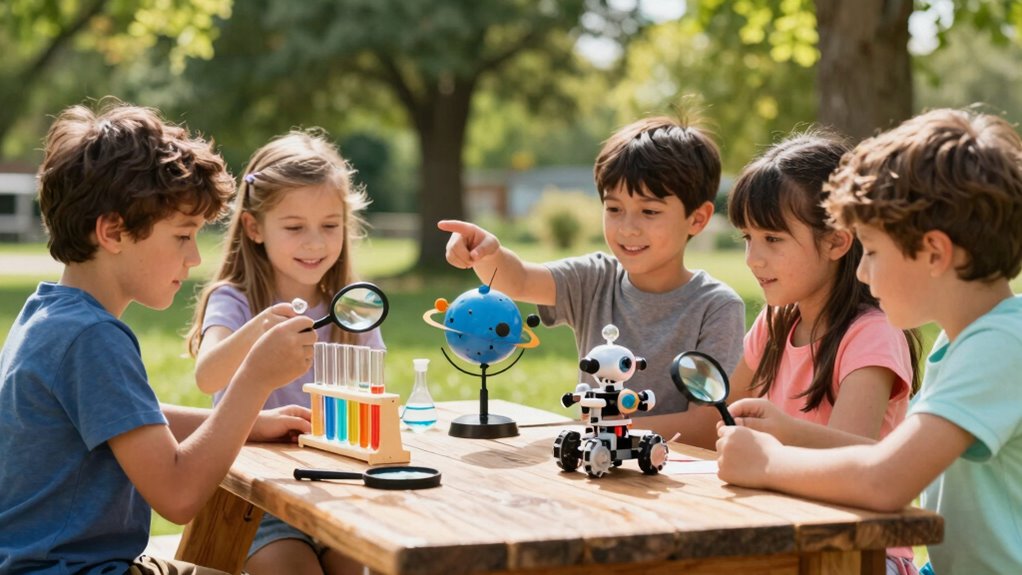

To bring more science talk into daily play, actively observe and talk about what’s happening around your child. Use everyday activities like baking or water play to explain scientific concepts, asking questions like “What do you think will happen?” or “Why did that happen?” Encourage predictions and discussions, and explore nature together to connect concepts to real life. Keep the conversation curious and engaging, and you’ll discover simple ways to make science a natural part of your child’s daily life.
Key Takeaways
- Integrate scientific language and questions during everyday activities, like asking, “What do you think will happen?” during play.
- Use outdoor exploration to observe nature and discuss concepts like ecosystems, plant growth, and weather patterns.
- Encourage predictions and active observation before, during, and after experiments or play scenarios.
- Incorporate hands-on experiments with common household items to explore scientific principles in a fun, natural way.
- Actively participate, ask open-ended questions, and celebrate discoveries to foster curiosity and deepen scientific understanding.
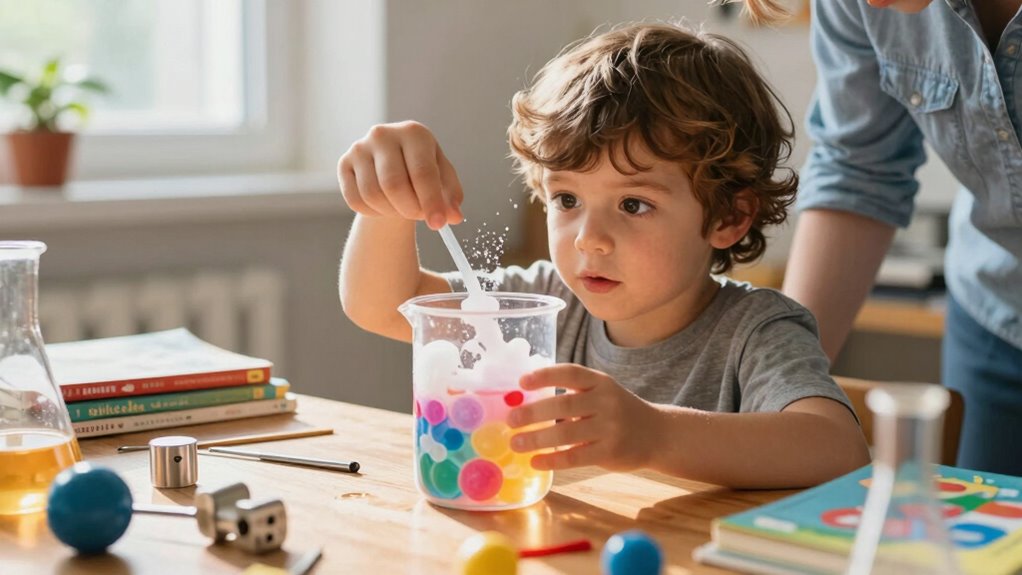
Incorporating more science talk into daily play can spark curiosity and deepen your child’s understanding of the world around them. When you introduce simple science experiments or encourage nature exploration during everyday activities, you’re helping your child see science as an exciting part of life. You don’t need fancy equipment or complex concepts—just a curious mindset and a willingness to explore together.
Start by turning routine activities into opportunities for science experiments. For example, while baking, you can explain how yeast causes bread to rise or how temperature affects the baking process. During water play, let your child observe how different objects sink or float, prompting questions like, “Why does this block stay on top but this one sinks?” These small experiments make science tangible and relatable. As you do this, use active language that invites your child to predict, observe, and discuss. Say things like, “What do you think will happen if we add more salt to the water?” or “Let’s see how long it takes for this ice cube to melt.” This approach encourages critical thinking and makes science feel like an ongoing adventure.
Turn daily routines into fun science experiments—predict, observe, and explore together for a curious, hands-on learning experience.
Nature exploration is another powerful way to incorporate science talk into daily play. Take walks in the park or backyard and point out different plants, insects, and animals. Ask open-ended questions: “Why do you think bees visit flowers?” or “What do you notice about this leaf’s color and texture?” Encourage your child to touch, smell, and observe their surroundings closely. Collect leaves, rocks, or sticks and discuss their properties. This hands-on exploration helps your child learn about nature’s diversity and the scientific principles behind it. You can even set up simple experiments outdoors, like planting seeds and observing their growth over time, or watching how water soaks into different types of soil. These activities naturally lead to conversations about ecosystems, life cycles, and weather patterns. Additionally, exploring local Prairie Scenery and wildlife can foster an appreciation for natural habitats and biodiversity. Incorporating scientific principles into outdoor activities can deepen understanding and make learning more meaningful.
To further enhance these experiences, consider using visual aids like drawings or diagrams to help your child understand complex concepts during your explorations. Throughout all these activities, your role is to be an active participant, guiding your child’s curiosity without dominating it. Ask questions that prompt deeper thinking, and listen carefully to their ideas and observations. Celebrate their discoveries, no matter how small, and encourage ongoing investigation. When you make science a natural part of daily routines, your child begins to see it as an integral part of life, not just a subject to learn in school. This mindset fosters lifelong curiosity and confidence in their ability to understand and investigate the world around them. By blending science experiments with nature exploration during your daily play, you create a rich environment where curiosity blossoms and learning becomes an exciting, continuous journey.
As an affiliate, we earn on qualifying purchases.
Frequently Asked Questions
How Can I Make Science Fun for Very Young Children?
You can make science fun for very young children through engaging science storytelling and nature exploration. Use stories about animals, plants, or weather to spark curiosity, making science relatable and exciting. Take them outside to explore nature firsthand—collect leaves, observe insects, or watch clouds—to encourage hands-on learning. This approach transforms everyday play into an adventure, helping children develop a love for science while discovering the wonders of the natural world around them.
What Are Simple Science Activities I Can Do at Home?
Imagine a sunny afternoon where you and your child explore the backyard, turning leaves and rocks into science experiments. You can create simple activities like mixing baking soda and vinegar to watch fizz or observing insects and plants during nature exploration. These activities spark curiosity and teach basic scientific concepts, making learning fun and engaging without needing special equipment. Just step outside and let nature and everyday household items do the work!
How Do I Encourage Curiosity During Science Play?
You can encourage curiosity during science play by asking open-ended inquiry questions like, “What do you think will happen if…?” and introducing science vocabulary to explain concepts. Show genuine interest in their ideas, and prompt them to explore further. Provide materials that invite experimentation, and celebrate their discoveries. This approach makes science engaging, helps develop their curiosity, and builds confidence in asking their own inquiry questions.
When Is the Best Time to Introduce Complex Science Concepts?
You should introduce complex science concepts when your child shows genuine interest or asks questions about a topic. Use simple science vocabulary to build their understanding, then gradually explain the concepts in relatable ways. This approach sparks curiosity and makes learning natural. Timing is key—wait until they’re engaged, then explore the concept explanation with hands-on activities, turning everyday moments into opportunities for meaningful science talk.
How Do I Balance Science Talk With Other Types of Play?
You should balance science talk with other types of play by integrating language naturally into play-based learning. For example, while building with blocks, describe the gravity or balance; during pretend play, introduce scientific concepts like ecosystems. Use open-ended questions to encourage curiosity and conversation. This approach keeps play engaging and varied while seamlessly weaving science talk into everyday activities, fostering learning without overwhelming your child.
children's outdoor exploration set
As an affiliate, we earn on qualifying purchases.
As an affiliate, we earn on qualifying purchases.
Conclusion
By weaving science talk into your daily play, you’re planting seeds of curiosity that grow into a lush garden of knowledge. Think of your conversations as a compass guiding your child through uncharted waters, revealing new worlds of discovery. When you embrace these moments, you turn everyday play into a vibrant tapestry of learning. Soon, science becomes second nature—a natural rhythm in your child’s world, fueling their wonder and inspiring endless exploration.
As an affiliate, we earn on qualifying purchases.
nature discovery activity kits for kids
As an affiliate, we earn on qualifying purchases.
As an affiliate, we earn on qualifying purchases.